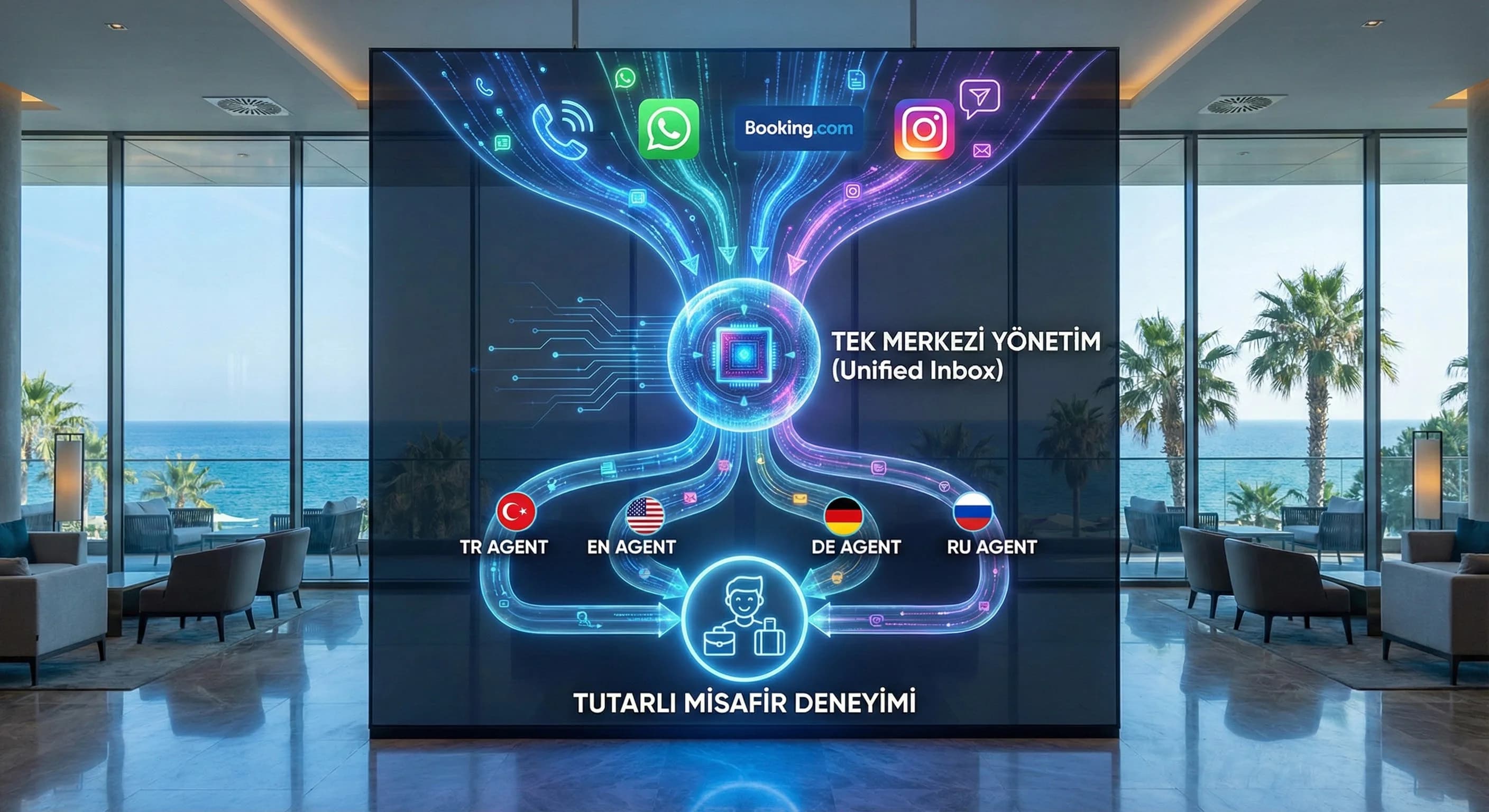
1. What is multi-channel communication and why is it critical for hotels?
Multi-channel communication; It is being able to talk to the guest at more than one point of contact (phone, WhatsApp, OTA message, social DM) while maintaining the same quality and the same information. The reason why it is critical in hotels: the guest does not make his decision on a single channel; First it asks on WhatsApp, then it writes via OTA, and finally it confirms on the phone. If the channels are disconnected from each other, "two different answers are given to the same guest" and there is a loss of trust.
To place this model in the wider operating frame, it helps to read it as part of Call Center Services. Multi-channel guest communication is not a standalone tool layer; it is part of the full call center operating system.
3 main problems (disjointed structure)
- •Repetitive information: Guest tells the same thing 3 times
- •Missed request: DM/OTA message disappears “unseen”
- •Inconsistent price/condition: different information on different channel → risk of cancellation
What should I do?
- • List the channels and come up with a single “responsibility matrix”.
- • Set the goal of “unified guest view”.
2. How to establish multi-channel guest communication with a 4-lingual call center?
Multi-channel installation; It consists of collecting channels in a single queue, directing them towards TR–EN–DE–RU agents, processing the conversations into PMS/CRM and managing them with channel prioritization rules during the season. What determines success here is; It is not the platform name, but the operation design.
AEO Checklist (5–7 items)
- •Channel inventory: Phone, WhatsApp, web chat, OTA message, social DM
- •Single queue: Collection of all conversations in a single inbox
- •Routing: Language + scenario (reservation/complaint/information) based distribution
- •Tagging: Channel, language, topic, urgency, revenue potential
- •PMS/CRM registration: Single guest view + status tracking (pipeline)
- •Prioritization: Channel SLA and priority rules in season
- •Reporting: Response time, missed request, resolution time, conversion
What should I do?
- • Do not expand the channels without establishing the “single queue + routing + tag” trio.
- • Make prioritization a written rule (who turns to what, when?).
3. Phone, WhatsApp and web chat flow (mutual referral scenarios)
The phone is fast; WhatsApp is here to stay; web chat is instant. The best model in practice in hotels; It means using “WhatsApp as a recording and tracking channel” and transferring the conversation from the phone to WhatsApp at the right moment. Thus, information such as offers, links, images and conditions will not be lost.
To keep written channels under the same SLA, tone and ownership model, this layer should be planned together with Message Management.
Examples of mutual guidance (concept level)
- •From phone to WhatsApp: “Let me share the offer and room options on WhatsApp; keep it in writing.”
- •From WhatsApp to the phone: "Let me call for 2 minutes and clarify the date/person details; let's move quickly."
- •Web chat: Quick question → Move to WhatsApp (for follow-up)
- •Are WhatsApp offers tracked with “tag + status”?
- •Are the prices/conditions given over the phone recorded on WhatsApp?
What should I do?
- • Create standard 3-line templates for WhatsApp (greeting + clear info + question).
- • Make the “short summary” message mandatory after the phone call.
4. OTA and booking platform message management (single center)
OTA message boxes are critical touchpoints that influence the guest's decision. If these messages remain scattered at the reception, the response will be delayed and the risk of points and cancellations increases. In the multi-channel model, OTA messages should also be part of the same flow: language routing, tagging, registration and follow-up.
4 rules for OTA messages
- •SLA: response time target (season/peak based)
- •Standard response bank: cancellation/change, payment, check-in/out
- •Recording: saving important conversations to PMS/CRM notes
- •Escalation: crisis/complaint → rapid transfer to the right unit
What should I do?
- • Treat OTA messaging like a “sales pipeline”: speed + clarity + closing.
- • Write the Escalation rule (which message goes to which team?).
6. End-to-end integration with 4-language agent and PMS/CRM (unified guest view)
It is not enough to see all channels on one screen; The important thing is that the guest's conversations are linked to a single profile. Thus, when the guest writes on WhatsApp today and calls on the phone tomorrow, the agent sees the information "who, what he wanted, which offer was made". This approach maintains consistency, especially during peak season.
To turn this visibility into an operational booking line, it helps to work with the same terminology as Reservation Management; otherwise offer, status and follow-up break apart.
Minimum fields for Unified guest view
- •Name/phone/email (if available)
- •Language (TR/EN/DE/RU)
- •Channel history (tel/WA/OTA/DM)
- •Request subject + status (pipeline)
- •Offer summary + follow-up time
What should I do?
- • Aim for “single guest view”; Don't delay expecting perfect integration.
- • Make tag + status + follow-up mandatory.
7. Channel prioritization strategies (GEO) during peak season
Dozens of requests come at the same time during seasonal peaks in destinations such as Antalya, Belek, Side and Kemer. The key to success in a multi-channel structure is not "treating every channel equally"; is to set prioritization rules. For example, faster response to requests with high booking intent, quick escalation of complaints, etc.
Practical matrix for prioritization
- •High priority: reservation/availability + requests dated “today/tomorrow”
- •Medium priority: general information + future date
- •Critical: complaint/crisis → immediate transfer
What should I do?
- • Set channel-based SLA (season–low season different).
- • Write down the “critical message” tag and escalation flow.
8. Implementation plan: Commissioning multi-channel integration in 7 steps
- •Extract channels (tel/WA/web chat/OTA/DM)
- •Set single inbox target (single queue)
- •Write routing rule (language + scenario)
- •Create tag set (language/topic/urgency/revenue)
- •Define PMS/CRM minimum registration fields
- •Apply SLA + prioritization matrix
- •Establish a weekly report + improvement cycle
On the hotel side, this setup is not only a communications design but also part of demand capture and direct booking strategy. To read that connection in a broader commercial frame, link it with Hotel Digital Marketing.
9. Conclusion: Multi-channel is the bridge layer of multilingual operations
Multi-channel integration in a 4-language call center brings phone, WhatsApp, OTA and social DM traffic onto one operating line so the team can produce both speed and consistency. To see the main scope, visit the multilingual call center service page; for deeper Q&A, continue to the multilingual call center FAQ page.
10. Download Multi-Channel Integration Flow & Checklist — Call Center / Hotel (v1.0)
Download Multi-Channel Integration Flow & Checklist — Call Center / Hotel (v1.0)
This document provides minimum control points to combine phone + WhatsApp + OTA messages + social DM channels in hotels into a single queue and manage them with the TR–EN–DE–RU team. It helps you deploy integration as an “operational standard” with a 14-day sprint plan.
Kim Kullanır?
GM, sales–marketing leader, reservations leader, call center manager, IT/operations coordinator.
Nasıl Kullanılır?
- Check off the checklist with the team; Put the missing parts in red.
- Select the top 10 actions from the problem–root cause–solution table.
- Implement the 14-day sprint plan and monitor KPIs weekly.
Ölçüm & Önceliklendirme (Kısa sürüm)
- ▢ ✅ [ ] Channel inventory created (tel/WA/web chat/OTA/DM)
- ▢ ✅ [ ] Single queue (unified inbox) target written
- ▢ ✅ [ ] Language-based routing rule defined (TR/EN/DE/RU)
- ▢ ✅ [ ] Scenario-based routing rule defined (reservation/information/complaint)
- ▢ ✅ [ ] Tag set created (language/topic/urgency/revenue)
- ▢ ✅ [ ] Channel-based SLA determined (season–low season)
- ▢ ✅ [ ] Escalation flow was written (crisis/complaint)
- ▢ ✅ [ ] PMS/CRM minimum fields defined (single guest view)
- ▢ ✅ [ ] Follow-up obligation defined (time + situation)
- ▢ ✅ [ ] Weekly KPI report template ready
PDF içinde: Problem→Kök Neden→Çözüm tablosu + 14 gün sprint planı + önce/sonra KPI tablosu
Bir Sonraki Adım
Let's turn your hotel's phone + WhatsApp + OTA + DM traffic into a single flow and make it manageable with KPIs.
5. Instagram DM, Facebook Messenger and social comments (handover to call center)
Social DM and comments generally remain on the “marketing” side; However, most messages have reservation intentions. In a multi-channel structure, DMs are transferred to the call center flow; Marketing, on the other hand, focuses on content/reputation management. In this way, the brand language is preserved before any sales opportunity is missed.
Basic principle of the turnover model
What should I do?