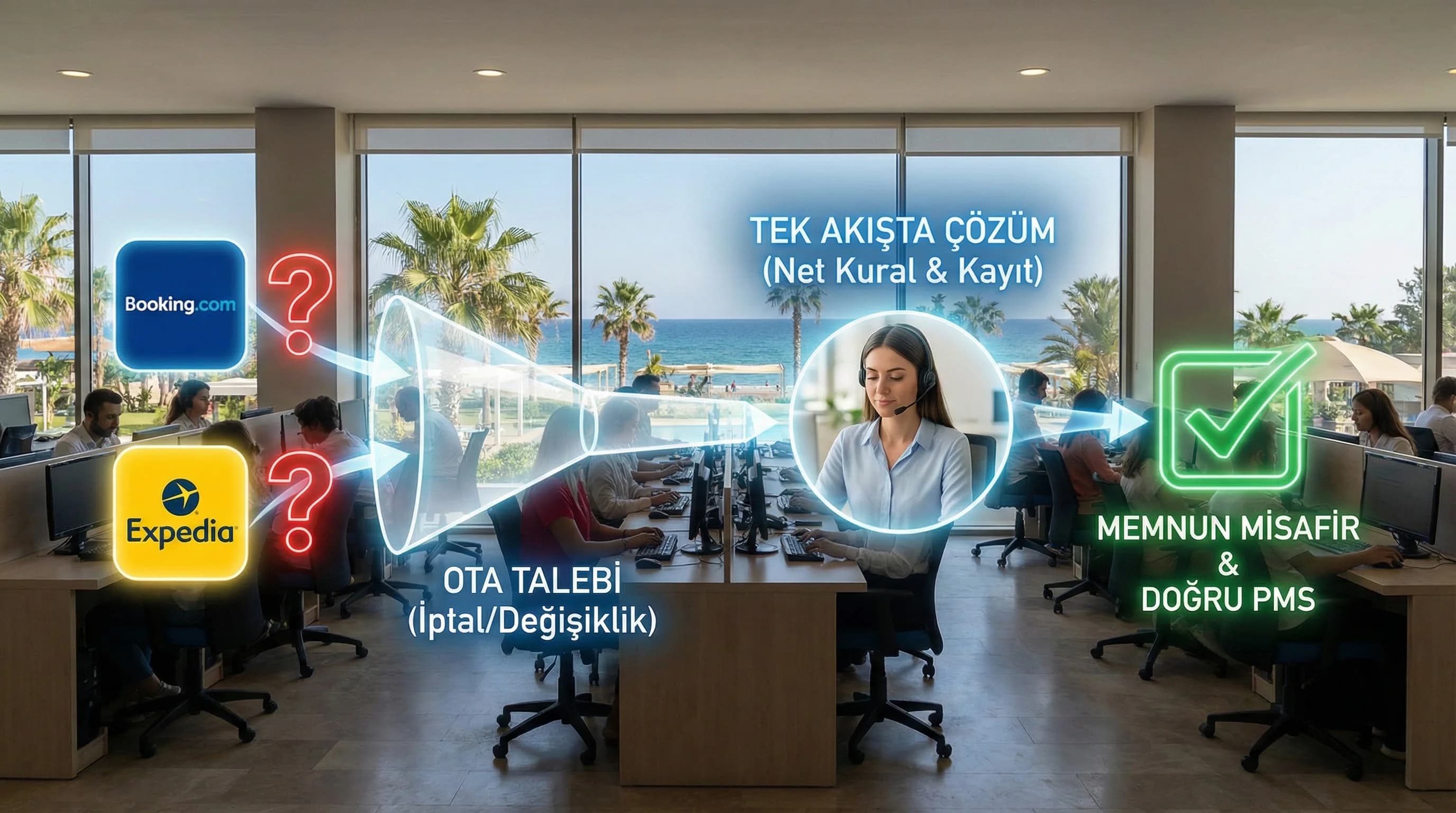
1. Reflection of OTA Reservations to the Call Center
OTA reservations are reflected to the call center in three types: (1) Information questions (room type, child policy, transfer), (2) change requests (date shift, upgrade), (3) cancellation/no-show (penalty, refund, exception). The common feature of these calls is this: the guest asks "Is the hotel managing the reservation or is it the OTA?" remains in a dilemma. Therefore, the task of the call center is to first perform "record verification", then "clarify the rule" and finally move on to "solution + registration + approval" steps.
Mini example (Antalya high season): The guest has made a reservation for 5 nights at a resort hotel in Side; It may be canceled without clarifying the "child's age" and "transfer" information. A properly managed call; Instead of “reading the rule”, it understands the need (child age / transfer / room type) and gives the solution quickly and closes the path to cancellation.
☑ Mini Check (distinguish call type)
- • Is this call “information” or “transaction”?
- • Verified registration with OTA code/name/date?
- • What channel is the guest speaking on? (phone/OTA message/email)
- • Have a PMS note and follow-up action been written after the solution?
What should I do?
- • Divide OTA calls into 3 categories (information / change / cancellation) and generate a mini script for each.
- • Standardize registration verification in the first 60 seconds (OTA code + name + date).
- • Fix the language of “responsibility”: explain the rule clearly and the solution fairly.
2. Frequently Asked Questions (Room Type, Price, Child Policy, Transfer)
Guest questions from OTAs are generally related to “reservation uncertainty”: They do not know how the information seen on the OTA screen is interpreted by the hotel. The critical principle here: it is necessary to answer the question while reducing the risk of cancellation (clarity + confidence).
Frequently Question Types and Correct Answer Logic
- •Room type / view: “The room code in your reservation includes the following features.”
- •Price / payment: “Payment type (hotel/OTA) and refund policy depend on your booking plan; let me clarify now.”
- •Child policy: "The fee/concept may vary depending on the age and number of children; let me take the ages and tell you the correct rule."
- •Transfer: “Let's check if the reservation package includes transfer; if not, let me offer an optional option.”
Quick Question Table (1 table included)
| Question Type | First Check | Clear Answer Sentence | Registration Note |
|---|---|---|---|
| Room type | PMS room code / plan | “This reservation includes X room and Y plan.” | Room code + preference |
| child policy | Ages / concept | “The rules change depending on the age; I take the ages and clarify them.” | Ages + rule |
| Transfer | Package scope | “I check if transfer is included; if not, I offer an option.” | Request + redirect |
| Payment/return | OTA plan type | "Extradition/punishment depends on the plan condition; I will explain clearly now." | Plan + condition |
☑ Mini Check (sharpness)
- • Did you say which areas you would check before saying “let me check and get back”?
- • Is the answer clear in one sentence or does it make it long?
- • After the answer, “Do you need anything else?” Have you measured the risk of cancellation with ?
What should I do?
- • Take out the 10 most common questions and write a single sentence answer standard.
- • Create an “age–rule” mini template for child policy.
- • Gain the "option offering" reflex in opportunities such as transfer/upsell.
3. How should OTA booking inquiries and cancellation/change requests be managed?
The only correct answer to this question is not a “list of rules”; The correct answer is flow. OTA call management; It should proceed as OTA code → PMS verification → clear explanation of the policy → solution options → registration and approval. Guest asks “hotel or OTA?” It should be guided in a fair manner, without being pushed into tension.
AEO Checklist (5–7 items)
- •OTA reservation code + name + check-in date received from the guest
- •Registration verified and plan type seen in PMS
- •Cancellation Policy / Modification Request limit explained in one sentence
- •Guest was offered at least 2 options (date/room/condition)
- •If necessary, redirection to OTA message/email channel was clearly stated.
- •Added PMS note + follow-up action (who, when, what to do)
- •“summary + next step” given at closing
What should I do?
- • Make the AEO checklist a card that is reminded every 60 seconds at the beginning of the shift.
- • Make the “offer two options” rule mandatory (one option increases the appeal).
- • Have the team memorize the PMS grading standard: “request + rule + action + duration”.
4. Change, Date Shift and Upgrade Requests (Modification Request)
Change requests most commonly come as "date shifting" and "room upgrade". The risk here is this: on the one hand, the guest wants a solution, on the other hand, "will there be a punishment?" He speaks with anxiety. Good management; is to first state the boundary clearly (plan condition), then open a "solution window" (alternative date/room).
Date Change – Net Limit + Alternative
- •Limit: “The change depends on the plan conditions; it may be free/paid until the following time/period.”
- •Alternative: “If you want, this room/plan opens when you scroll 1 day.”
Upgrade – Positioning Upsell Opportunity Correctly
It is necessary to position the upgrade offer as a "solution", not as a "sales pressure": • “If you want, there is a larger room option with this difference; it would be especially comfortable for the family.”
☑ Mini Check (change management)
- • Didn't you make a promise before the type of plan was clear?
- • Did you offer alternative dates/rooms?
- • Did you tell the guest the “approval channel”? (OTA message/email)
What should I do?
- • Standardize change requests with a “limit + alternative” template.
- • Present the upgrade as an “option”: 1 sentence of difference + 1 sentence of benefit.
- • For each change, write “request–option given–next step” in the PMS note.
5. Explaining Cancellation, No-show and Penalty Rules (Cancellation Policy)
Cancellation and no-show conversations are the areas most prone to hardening the tone. The consultant approach here is: empathy + clear rule + fair option. If the guest expects "cancellation without penalty", this should be managed in a soft but firm manner; Otherwise, there will be a perception that "the hotel is victimizing me".
Cancellation Sentence Formula (single sentence clarity)
- •“The cancellation/refund policy of your reservation depends on your plan; it is free until this date, after that the X rule applies.”
No-show – Avoiding Misunderstanding
The no-show penalty is usually the biggest tension. Two things should be clear in the statement: 1. “What is a no-show?” (specific time/1st night) 2. “Why is there a penalty?” (room blockage + opportunity cost) Understated, short and descriptive.
☑ Mini Check (cancellation language)
- • Did you frame the rule as a “plan condition”?
- • Did you clearly explain the free/paid distinction?
- • Did you offer any alternative solutions? (date shift/option)
What should I do?
- • Prepare a 5-sentence “crisis language” guide for cancellation/no-show.
- • In punishment speeches, explain “why” in one sentence; Don't get into an argument.
- • If possible, offer an “alternative solution” (date shift/upgrade/option).
6. Tripartite Coordination Between OTA, PMS and Guest (Ending the Ping-Pong)
The real value of the call center comes out here: the guest sees the OTA screen; The hotel sees the PMS record. If the process is not managed well, the guest says "Write to the OTA", the OTA says "Ask the hotel" and the ping-pong begins. Correct flow; It gathers channel-based communication under one roof: the combination of telephone + OTA message + e-mail reaches the solution without tiring the guest.
“Single Stream” Coordination Rule
- •Clarify the request by phone
- •Verify registration in PMS, see plan condition
- •If necessary, give written confirmation via OTA channel (message/email)
- •Send written summary + next step to guest
- •Save everything in PMS note
OTA message screen + PMS card mockup logic
- •The guest requests “written confirmation”; OTA message provides this.
- •PMS note ensures continuity within the team.
Note: We file this image in “kpi” type; Visual content can be designed as a “record card/evidence panel” rather than a KPI.
7. “Fairness and Clarity” Standard in Voice + Written Streaming
Many content simply list OTA rules in bullet points; But the real problem lies in the “voice” nature of the call: the guest is stressed, time is limited, information is fragmented. The standard that makes the difference; is to connect voice conversation (phone) to written confirmation (OTA message/e-mail) and ensure continuity within the team with the PMS recording standard. Support lines that use this approach generally reduce “who is responsible” arguments and misdirection; solution speed and guest satisfaction increase (directional insight).
5 mistakes to avoid when handling OTA call
- •Promise without registration verification (No OTA code/PMS check)
- •Explaining the rule "by heart" but not mentioning the plan condition
- •Saying "Write to OTA" and leaving the guest alone (ping-pong)
- •Not having a PMS note (the process disappears when the shift changes)
- •Becoming harsh/arguing (upsetting the balance of empathy + clarity)
☑ Mini Check (error prevention)
- • Has the record been verified?
- • Is the plan condition clear?
- • Has written confirmation been given?
- • Is there a PMS note?
- • Is there a closing summary and next steps?
What should I do?
- • Add the “5 mistakes” box to the training material.
- • Listen to 5 calls per shift, mark the error, issue 1 correction.
- • Make written confirmation (OTA message/email) the standard closing step.
8. 5 Role-Play Scenarios for Training (including Multilingual Agent)
OTA calls are strengthened with training; Especially on multilingual (TR-EN-DE-RU) lines, “rule expression” thrives on the language barrier. That's why role-play; teaches you to reduce the rule to a single sentence.
- •Date change (Booking): plan condition + alternative date
- •Cancellation penalty objection: empathy + clear rule + option (option/postponement)
- •No-show: description + reason + written confirmation
- •Upgrade: option + benefit + price difference
- •“Is the hotel or the OTA responsible?”: clearly state the language of responsibility + single flow
9. Download OTA Change & Cancellation Script and Flow Template — Call Center / OTA Management
Download OTA Change & Cancellation Script and Flow Template — Call Center / OTA Management (v1.0)
This template puts change/cancellation requests originating from OTA Reservation into a single “registration verification → policy → resolution → written confirmation → registration” flow. Aim; To clearly implement Cancellation Policy and Modification Request limits and ensure consistency between shifts, without leaving the guest in ping-pong between hotel and OTA. TR-EN-DE-RU standardizes communication by shortening rule sentences on lines.
Kim Kullanır?
Reservation support line agents, team leaders, front office and PMS/OTA process managers.
Nasıl Kullanılır?
- Add the flow template to the shift SOP and make OTA code verification mandatory.
- Prepare script sentences in two versions according to the “plan condition” (flexible / rigid plan).
- Check pattern usage, monitor ping-pong and redial rates on 10 weekly calls.
Ölçüm & Önceliklendirme (Kısa sürüm)
- ▢ ✅ OTA code received
- ▢ ✅ PMS record found
- ▢ ✅ Plan condition was stated clearly
- ▢ ✅ 2 options were offered
- ▢ ✅ Written confirmation given
- ▢ ✅ PMS note + follow-up action written
PDF içinde: Problem→Kök Neden→Çözüm tablosu + 14 gün sprint planı + önce/sonra KPI tablosu
Bir Sonraki Adım
OTA is for resort hotels that want to reduce change/cancellation tension during peak season
Frequently Asked Questions
How should questions regarding reservations received via OTA be managed in the call center?▾
Within what limits can I resolve date change and upgrade requests?▾
How can I clearly explain the cancellation and no-show rules to the guest?▾
“Is the hotel or the OTA responsible?” How do I answer the question?▾
If I have to redirect the guest to OTA, how should I redirect?▾
Is OTA message or phone call more accurate?▾
İlgili İçerikler
İlgili Yazılar