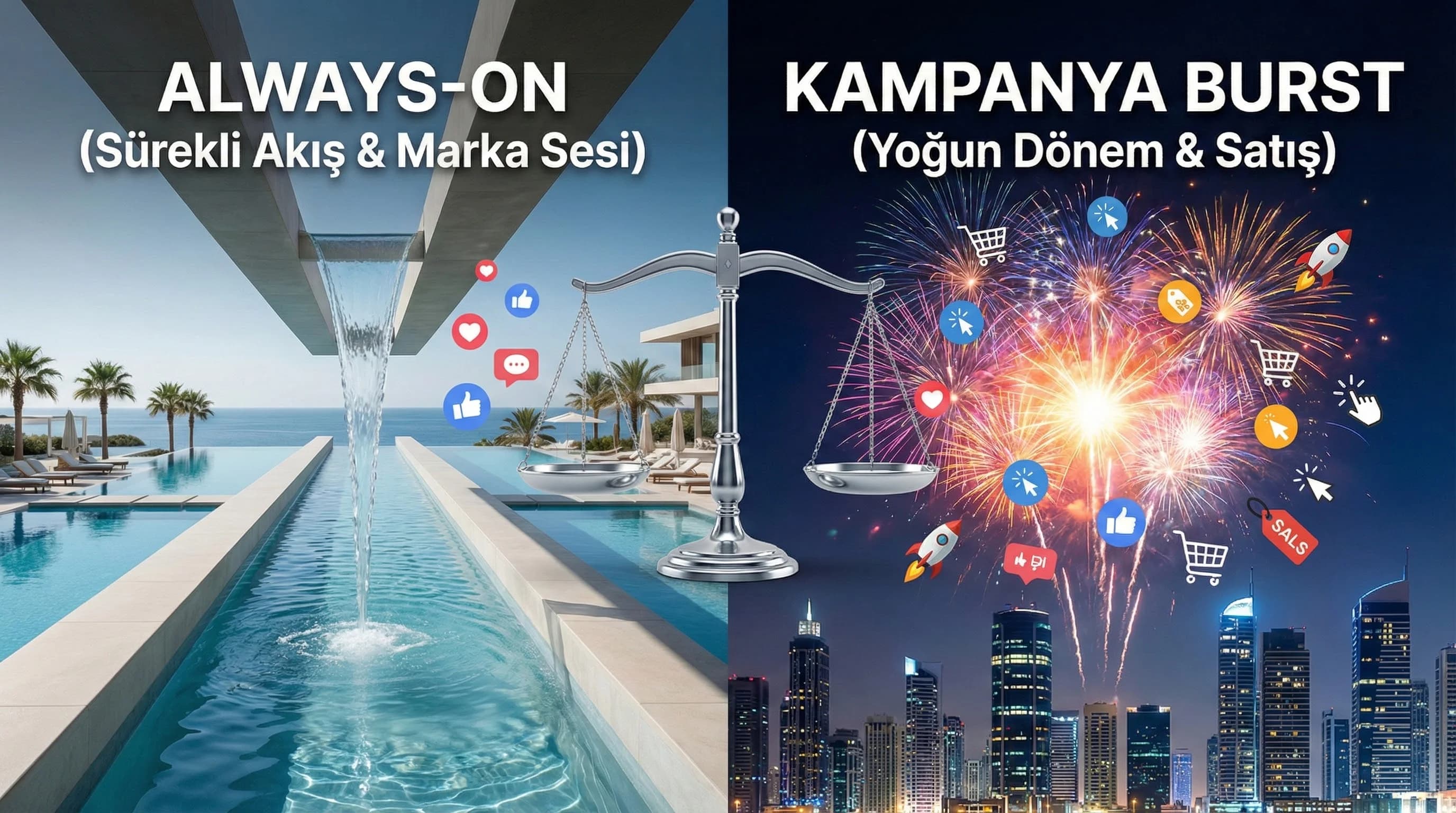
1. 1) What is Always-On? – “The brand voice should never be silent”
Always-on content is a content system that carries the brand's core identity, value proposition and trust elements independently of the campaign. The goal is not to “throw something away every day”; to continue the themes that define the brand throughout the year in repeatable formats. Always-on at the hotel; It is the trust-building layer such as experience, concept, UGC/reviews, destination and service standard. In B2B, frameworks, mini-lessons, case approach and expert opinion form the always-on backbone.
What is always-on content?
Always-on content types (example):
- •Brand story + value proposition (who does what differently?)
- •UGC/comment/social proof (trust layer)
- •“Mini guide” contents (problem→solution)
- •Destination/experience narration (hotel)
- •Framework + checklist + insight (B2B)
☑ Mini Check (Always-on intact?):
- • Do always-on content describe the “brand voice” in a single sentence?
- • Are there 2–3 repeatable formats each month? (carousel/reel/video)
- • Is UGC/social proof in order?
- • Are KPIs measured separately from the campaign?
What should I do?
- • Specify 4–6 content batteries for always-on.
- • Choose 2 format standards for each pillar (e.g. carousel + reel).
- • Plan a set of “trust” content each month (comments, case, proof).
- • Monitor Always-on KPIs in a separate dashboard.
2. 2) What is Campaign Based Content? – “Burst periods”
Campaign-based content is a short-term period of concentrated content and distribution aimed at a specific goal (sales, launch, announcement, event). Early reservations at hotels, season openings, special day packages; In B2B, bursts such as product launch, webinar, new service package are typical. Campaign contents enable quick decisions; so the message, offer, proof and CTA should be more direct.
What is the difference between campaign-based content and always-on?
Campaign content components:
- •Offer clarity (what is it, for whom, on what terms?)
- •Evidence (comment, guarantee, case, before/after)
- •CTA clarity (single action)
- •Burst rhythm (short duration + high frequency)
☑ Mini Check (Is the campaign ready?):
- • Is the proposal clear in 1 sentence?
- • Is there a single CTA? (DM/WhatsApp/form)
- • Are the 3 elements of evidence ready? (comment, image, condition transparency)
- • Do the burst duration and the number of contents match the capacity?
What should I do?
- • For the campaign, write the "offer-evidence-CTA" trio on a single page.
- • Plan burst duration between 7–21 days (Assumption: depending on season/launch).
- • Set up the content set in 3 stages: teaser → proof → closing/CTA.
- • Report campaign KPIs separately.
3. 3) Which one stands out in which situation? – “Decision matrix”
The mistake in many teams is this: when the campaign pressure increases, always-on is completely cut off; When the campaign ends, the account becomes silent. However, the best model is the one where always-on is the “base” and the campaign is added as a “burst” on top of it.
Should I share it constantly or in campaigns?
Decision matrix (practical):
- •Brand new / low confidence → Always-on weight (evidence and value proposition)
- •Season/launch period → Campaign burst weight (sales/announcement)
- •Product/service complex → Always-on training + “clear package” in the campaign
- •Capacity limited → little but continuous always-on + small burst
☑ Mini Check (Balance):
- • Does always-on “reset” during the campaign?
- • Does the account "go silent" after the campaign?
- • Are KPI targets separated by mode?
- • Is content production capacity exceeded?
What should I do?
- • Lock Always-on to “minimum weekly rhythm”.
- • Block campaign bursts in the calendar and pre-production.
- • Leave at least 1 always-on content per week, even during the campaign period (Assumption: based on capacity).
- • Add a 7-day “normalization” plan after the campaign.
4. 4) Balancing Always-On and Campaign in the Annual Plan – “Block plan”
An annual plan allows you to manage campaigns in calendar blocks rather than “as you think of them.” Seasons are clear in hotels; In B2B, launches and events can often be planned in advance. The thing to do is: place the campaign blocks, fill the gaps in between with always-on, and pre-define the KPI set of each block.
How do I balance campaign and always-on in an annual social media plan?
KPI separation (net):
- •Always-on KPI: reach trend, engagement rate, save, profile action
- •Campaign KPI: click, lead/DM, form, sale/booking signal (Assumption: if measurement infrastructure exists)
☑ Mini Check (Annual plan):
- • Are campaign blocks marked with their dates?
- • Have targets/KPIs been written for each block?
- • Have always-on pillars been distributed in the spaces?
- • Is production capacity compatible with the weekly limit?
What should I do?
- • Separate campaign blocks by color on the 12-month calendar.
- • Add a “quote–proof–CTA” card to each block.
- • Rotate always-on content on a pillar basis.
- • Report by mode: always-on vs campaign.
5. 5) Sample Calendars for Hotel and B2B – “Applicable distribution”
Seasonal blocks (early booking, summer season, holidays) are evident in hotel examples. In B2B, there are burst periods such as product/service launches, webinars and events. Recommendation in both scenarios: always-on's "base rhythm" should be constant, campaigns should be "planned burst".
Sample distribution (Assumption – initial model):
- •Hotel (seasonal): 60% always-on • 40% campaign (varies depending on the season)
- •B2B (launch focused): 70% always-on • 30% campaign (reversed during launch period)
☑ Mini Check (Adapting the sample calendar):
- • Are your season/launch dates clear?
- • Can always-on pillars be produced “every month”?
- • Is there a campaign pre-production period?
- • Is the measurement and revision rhythm planned?
What should I do?
- • Start with a “simple distribution” in the first year and revise it in 90 days.
- • Power the best performing pillars always-on.
- • Increase the “quality of evidence” in campaign blocks, not the number of content.
- • Conduct a block-based retrospective at the end of the year.
6. Always-on and Campaign Content Distribution Table
| mode | Aim | Typical ingredients | KPI | Calendar use |
|---|---|---|---|---|
| Always-on | Brand voice + trust | UGC, guide, value proposition | access, interact, save | year-round base rhythm |
| Campaign burst | Sale/announcement | offer, launch, closing | click, lead/booking | block periods (7–21 days) |
7. Download Always-On + Campaign-Based Annual Planning Template — Annual SMM Plan (v1.0)
Download Always-On + Campaign-Based Annual Planning Template — Annual SMM Plan (v1.0)
This template is for you to plan always-on content rotation and campaign burst blocks on a single annual calendar. It allows you to manage hotel seasonality and B2B launch rhythm in the same model. It reduces the risk of “too much content – little impact” by standardizing KPI separation and production capacity control.
Kim Kullanır?
Hotel sales-marketing team, GM, B2B marketing leader or agency strategy/operations team.
Nasıl Kullanılır?
- Block campaign/launch dates of the year (7–21 days).
- Distribute always-on pillars into spaces on a monthly rotation.
- Write KPI targets based on mode and compare always-on vs campaign in the monthly report.
Ölçüm & Önceliklendirme (Kısa sürüm)
- ▢ ✅ Always-on base rhythm locked to “minimum”
- ▢ ✅ Campaign blocks planned first, gaps filled later
- ▢ ✅ KPIs were separated by mode, not mixed in a single table
- ▢ ✅ Campaigns that exceeded capacity were scaled back; quality maintained
- ▢ ✅ Block-based retrospective planned at the end of the year
PDF içinde: Problem→Kök Neden→Çözüm tablosu + 14 gün sprint planı + önce/sonra KPI tablosu
8. Result: The model that establishes the balance is the “base + burst” plan
Neither accounts that share only during campaign periods nor accounts that share constantly without any campaign will be sustainable in the long run. Healthy model; While keeping the "brand voice" constantly visible with always-on content that carries the basic identity of the brand, it is to intensify sales and announcements with campaign burst content during periods such as seasons/launches. The annual plan always fills in campaign blocks and gaps in between; KPIs are also tracked separately for these two modes.
Bir Sonraki Adım
(to clarify the annual plan and establish KPI separation for seasonal hotel and B2B launch teams)