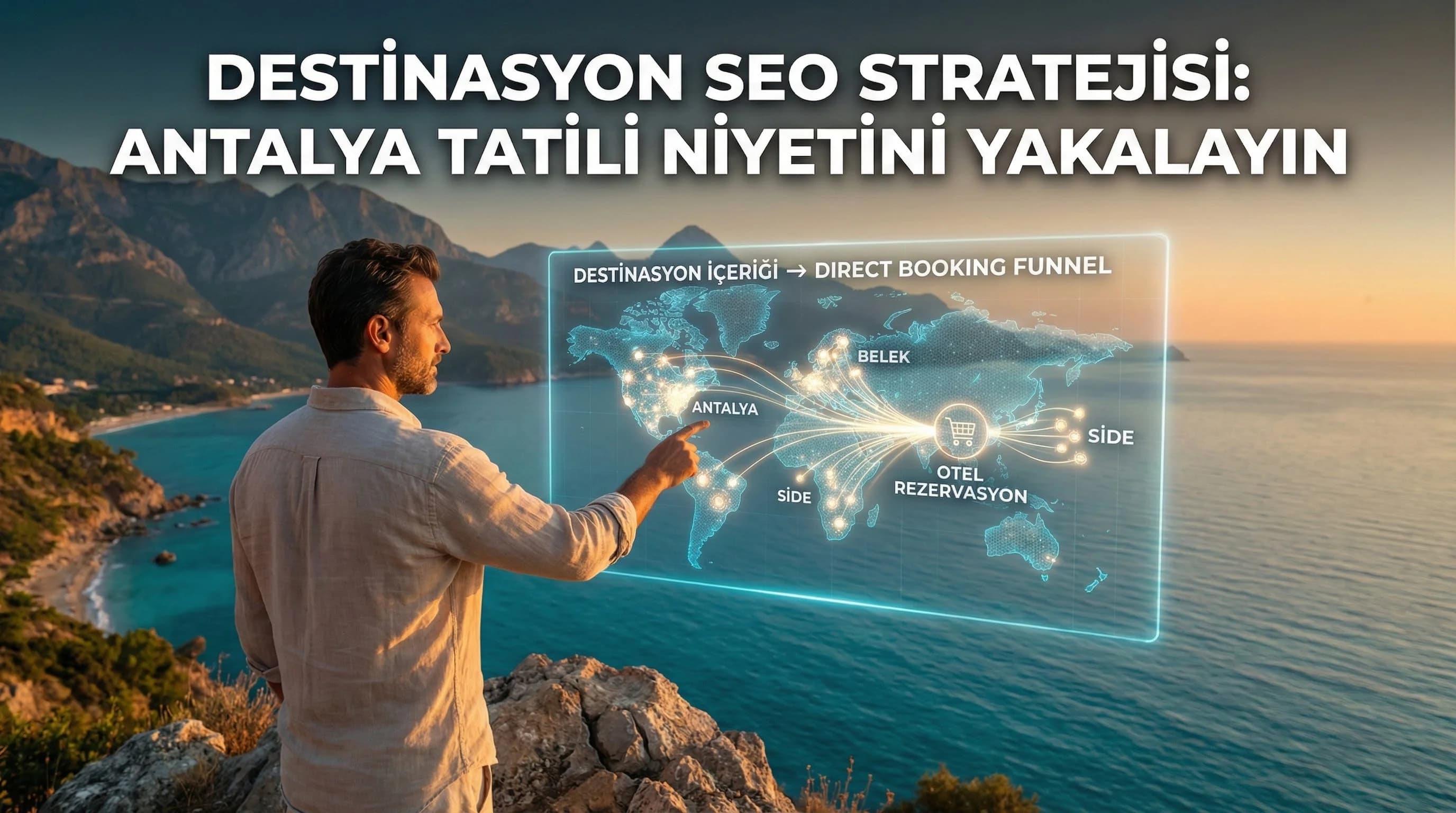
1. Why is destination content critical in hotel SEO?
The biggest shortcoming of hotel SEO is not being able to capture off-brand demand. Brand demand is limited; growth comes from destination/experience searches. Destination contents; It signals to Google that "this hotel is not just a building, it is a resource that describes this holiday experience." More importantly, with the right internal link and CTA structure, destination content becomes a path that connects “information” to the reservation.
How should hotel blogs be used for SEO?
Short answer (bullet mini answer):
- •Organize the blog as a topic cluster, not "individual posts".
- •Link to room/offer pages with 1–2 clear CTA blocks in each guide post.
- •Map segment (family/couple/golf/spa) contents to “room type” and “package” pages.
- •Add FAQ/Q&A blocks for guides and target SGE/Voice visibility.
Why isn't the "blog for traffic" approach enough?
Competing hotels write destination content, but most of them:
- •Does not put CTA,
- •The room/reservation does not provide internal links,
- •It does not establish a hub/cluster architecture.
Result: there is traffic but no reservations. The model of this article presents content architecture for “traffic + reservations”.
☑ Mini Check
- • Are destination contents in a “cluster map”?
- • Are there 1–2 internal links to the room/offer page in each article?
- • Are CTA blocks planned according to segments (family/couple/golf/spa)?
What should I do?
- • 1. Create a hub page + cluster plan for Antalya/Belek/Side.
- • 2. Standardize “room/concept” CTA blocks in each cluster post.
- • 3. Make the blog→room→booking chain measurable with analytics.
2. How to set up topic cluster for Antalya / Belek / Side?
Destination content should not be written randomly; A topic cluster architecture should be established as “hub → subtopics → segment contents”. The aim here is to both show subject authority to Google and take the user to the right next step in the decision journey.
Antalya destination hub: think of it like a home page
Assumption: “destination hub” works like a parent page within the blog:
- •“Where to stay in Antalya?” quick summary
- •Brief comparison by region (Belek/Side/Kemer)
- •Content entries by segments (family/couple/golf/spa)
- •“Rooms in this concept” CTA blocks
Sample cluster map (with AIO triple logic)
- •DestinationContent → leadsTo → Hotel & Room pages
- •Activity (golf/spa/family) → matches → RoomType/Offer
- •Season → influences → Destination choice
Example subsets:
- •Antalya Holiday: “first timers”, “transportation”, “season”
- •Belek: “golf”, “family resort”, “transfer”
- •Side: “historical trips”, “couple concept”, “beach”
☑ Mini Check
- • Does your hub page connect regions and segments in one place?
- • Does each sub-content point to the next step (room/offer)?
- • Is season and market (DE/UK/RU) context inherent in the content?
What should I do?
- • 1. Write the hub page in “table of contents + quick decision” format.
- • 2. Use 1 main segment and 1 room/offer CTA in each sub-content.
- • 3. Chain internal links: Hotel Digital → Hotel SEO → Destination hub → Blog → Room.
3. How to connect experience-based content (beach, family with children, spa, golf) to direct booking?
Experience content catches the user who does not know the “hotel name”. The critical point is to direct this user to a concept/room page within the hotel's own site, without losing them to the OTA list. For example, “family with children” content will eventually be transferred to the “Family Room” or “Kids Concept” page; “golf” content should be linked to “Golf package” or “Transfer near Belek” information.
What content should be written for the family with children segment?
Short answer (bullet mini answer):
- •“The best areas for families with children in Antalya”
- •“7 criteria when choosing a family resort in Belek”
- •“List of things to do with children in Side”
- •“Family room selection: square meters, bed, security, children's menu”
At the end of each article: “Check out our rooms in this concept” CTA + internal link to the relevant room page.
Content mapping for golf segment
- •“The best period for a Belek golf holiday” → season + transfer + package
- •“Room comfort and transportation when choosing a golf resort” → room page + reservation
In this way, informational intent is “flown” into BoFu pages.
☑ Mini Check
- • Does each experience content link to a “room/offer” page?
- • Are the CTAs in segment language (family, couple, golf)?
- • Is there a short program/plan (Antalya in x days) in the content?
What should I do?
- • 1. Match experience articles with room types (family room, sea view, swim-up).
- • 2. Position the CTA as a concept/room review, without shouting “booking”.
- • 3. Keep the user on the page and build trust with programs such as “Antalya in x days”.
4. How to set up the blog → room → reservation funnel?
The basic principle here: every content must have a “next step”. What will the user do after reading the guide? If the region is chosen, which room? If he chose a room, which offer? If this chain is not constructed, the user will go back to Google and go to OTA.
Internal link chain (suitable for locked targets)
- •Hotel SEO service page: https://dgtlface.com/en/hotel/seo
- •Hotel digital marketing hub: https://dgtlface.com/en/hotel
- •Content SEO: https://dgtlface.com/en/seo/content-seo
- •Local SEO: https://dgtlface.com/en/seo/local-seo
- •SMM content production (destination content process): https://dgtlface.com/en/smm/social-media-content
Funnel measurement (Assumption: standard of measurability)
- •“room page” link click on blog post
- •Booking Engine CTA click on the room page
- •Completing a reservation on booking engine
In this way, “does destination content really bring bookings?” The question becomes measurable.
☑ Mini Check
- • Are room/offer links measured in blog posts?
- • Is the room page CTA click tracked?
- • Is the Funnel report read monthly?
What should I do?
- • 1. Template CTA blocks (same format, different segment).
- • 2. “Proximity” logic in blog posts: the relevant room/offer link is on the same page.
- • 3. Set up the Funnel measurement with GA4/tagging and link it to the report.
5. How do you optimize destination content for SGE and Voice Search?
On the SGE and voice side, users are more "question" oriented: "Where should I go with my family in Antalya?" like. Therefore, destination content should be strengthened with quick answer blocks and mini summaries instead of classical long paragraphs.
How to connect Antalya destination content to direct booking?
Short answer (bullet mini answer):
- •Make H2's the question title and give a clear answer in 2-3 sentences right below it.
- •Provide “concept/room” anchor in the answer (family room, sea view, swim-up).
- •Include 1 “short program” (e.g. Antalya in 3 days) in each article.
- •Target the PAA area with FAQ blocks.
Conversational Q&A blocks for voice searches
Example voice chip tone:
- •“Belek is generally more comfortable for families with children; Side may be more advantageous for excursions.”
Then soft CTA like: “Check out our rooms in this concept.”
☑ Mini Check
- • Are there H2s with question titles and clear answer blocks?
- • Do Q&As connect to room/booking anchors?
- • Is the text colloquial and low in jargon?
What should I do?
- • 1. Include 3–5 question and answer blocks in each destination post.
- • 2. Place Voice-compatible summaries at the bottom of the first screen.
- • 3. Segment the CTA by “rooms in the concept”.
Key Statistics / Data Point (softened usage): It can be seen that in hotels sitting in destination clusters, the blog → room page transition rate and blog-based direct booking contribution can increase significantly (depending on the facility, content quality and link/CTA structure).
6. Don't leave the "Antalya hotel" race to OTA, capture the "Antalya holiday" intention yourself
Destination content is the most powerful lever that distinguishes your hotel from OTA listings: the right cluster, the right segment and the right internal link chain. The goal with this guide is; To establish a system that connects informational searches such as Antalya/Belek/Side to the room page and reservation engine. You can keep this structure evergreen by updating season samples and visual maps every year (Refresh 365).
7. Download Destination SEO Topic Cluster Drafts — Hotel SEO / Destination Content (v1.0)
Download Destination SEO Topic Cluster Drafts — Hotel SEO / Destination Content (v1.0)
This asset is designed for you to plan destination content for Antalya/Belek/Side/Kemer/Bodrum in hub + cluster logic and connect each content to the room/reservation step. Aim; It is to put the content system that produces traffic + reservations instead of “traffic” on a 90-day plan.
Kim Kullanır?
SEO/content team + sales-marketing (segment) + web team (CTA/link implementation).
Nasıl Kullanılır?
- Select the Hub page (Antalya Holiday Hub) and specify the subsegments (family/couple/golf/spa).
- For each cluster post, mark the “target room/offer” and CTA anchor.
- Place it on a 90-day publishing plan and set up blog→room→booking measurement.
Ölçüm & Önceliklendirme (Kısa sürüm)
- ▢ ✅ Hub page + 8–12 cluster posts planned
- ▢ ✅ Room/offer target defined in each article
- ▢ ✅ CTA text compatible with segment language
- ▢ ✅ Added Q&A blocks (3–5 questions)
- ▢ ✅ Measurement plan (blog→room→booking) established
PDF içinde: Problem→Kök Neden→Çözüm tablosu + 14 gün sprint planı + önce/sonra KPI tablosu
8. Antalya/Belek/Side segment → content → target page matching
| segment | Sample content title | Intent | target page | CTA anchor |
|---|---|---|---|---|
| family with children | The best areas for families with children in Antalya | Information → Decision | Family Room / Kids Concept | Check out our family rooms in this concept |
| Golf | Best period for Belek golf holiday | Information → Decision | Golf package / Transfer / Room | Check out our golf concept rooms |
| Spa/Relax | The best areas for a spa-focused holiday in Antalya | Information → Decision | Spa package / Room | Check out our spa concept rooms |
| Couple | Couple concept in Side: excursions + beach plan | Information → Decision | Honeymoon/Sea View / Offer | Check out our rooms with this concept |
Bir Sonraki Adım
To find the points where your destination content is lost to OTA and create a blog→room→reservation plan (for GM & sales-marketing).