
Hotel SEO – Professional Optimization for Top Rankings in Search Engines
DGTLFACE is a professional partner in hotel SEO, helping your hotel rank higher in real guest searches on Google through tourism-specific keyword strategy, technical SEO, and content optimization. For us, Hotel SEO is not just focusing on a few keywords; it is a reservation- and revenue-driven digital architecture where layers like hotel SEO strategy, tourism SEO, resort SEO, hotel Google rankings, and increasing organic traffic are handled together. Especially for hotels that want to reduce OTA dependency, increase direct booking share, and strengthen brand visibility, SEO is no longer “nice to have”—it’s a critical need at the level of “if we don’t do it, we struggle.”
What Is Hotel SEO, and Why Is It So Critical?
- Reduces OTA commissions,
- Increases brand awareness,
- Strengthens your “direct booking” muscle,
- Generates bookings at a lower cost in the long run.
- General vacation searches such as “hotel in [region]”, “[region] resort”, “[region] all inclusive hotel”,
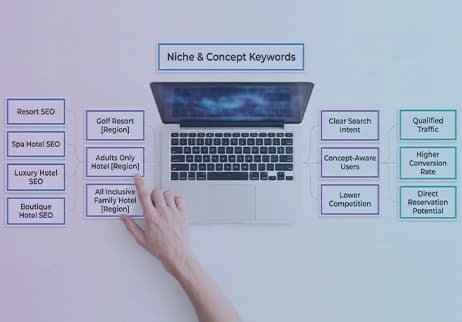
- Concept searches: spa hotel, luxury hotel, boutique hotel, golf hotel, family resort,
- Niche intent: “best family hotel in [region]”, “honeymoon hotel [region]”, “aquapark hotel”,
- Brand + region + concept combinations.
Summary
DGTLFACE brings together technical SEO, keyword strategy, content & blog architecture, Google Maps/Hotel/Travel optimization, and multilingual structure management under one roof. To increase direct booking share despite OTA competition, we redesign the entire site architecture—from room pages to destination content—based on tourism-focused SEO standards, building a sustainable system that turns organic traffic into real reservations.
Core Components of a Hotel SEO Strategy
- Technical SEO – Infrastructure, speed, mobile friendliness, crawlability, schema
- Content & Intent-Based SEO – Page structures, blog, destination content, image optimization
- Local & Multilingual SEO – Google Maps/Travel, local searches, multilingual architecture, market-based content
Keyword Strategy – Tourism-Specific Hotel SEO
Technical SEO – Bringing a Hotel Website Up to Google Standards
- Improves site speed and Core Web Vitals metrics (LCP, CLS, INP),
- Tests and fixes mobile compatibility,
- Makes URL, sitemap, robots.txt, and canonical structures Google-friendly,
- Ensures hotel pages are marked up with schema (Hotel, LocalBusiness, Offer) for Google Hotel / Google Travel visibility,
- Clears technical issues such as broken links, redirect problems, and index errors.
Content SEO – Blog and Content Strategy for Hotels
Local SEO and Google Maps – Standing Out in “Hotel + Region” Searches
- Optimizes your Google Business Profile / Google Maps listing,
- Edits categories, descriptions, photos, and attributes according to tourism SEO standards,
- Strengthens visibility in local + niche searches such as “Antalya hotel SEO, Belek hotel SEO, Kemer hotel SEO, Side resort SEO”,
- Makes review management a part of your hotel SEO strategy.
Booking Effect, OTA vs Hotel Website SEO Balance
DGTLFACE Hotel SEO Service Details
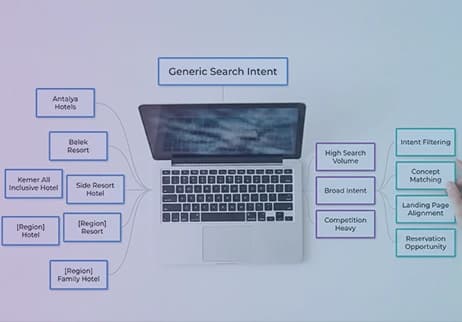
High-Intent Generic Keywords
Niche and Concept Keywords
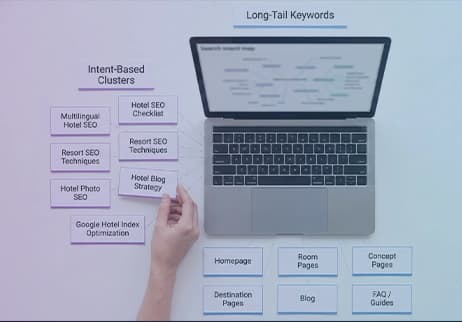
Long-Tail Keywords
- “how to do SEO for hotels”,
- “multilingual hotel SEO strategy”,
- “hotel website SEO checklist”,
- “how to optimize Google Hotel indexing”,
- “resort SEO techniques”,
- “blog strategy for hotels”,
- “hotel photo SEO optimization”.
- Homepage,
- Room & concept pages,
- Destination & blog content,
- FAQ and information pages.
Destination Guides
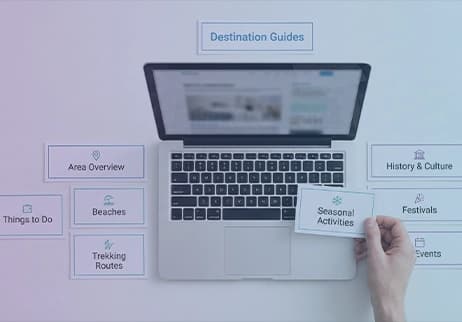

Concept Content
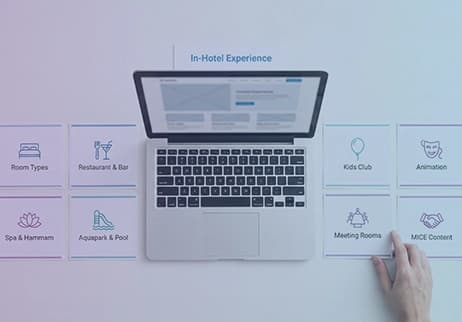
In-Hotel Experience Content
Blog Strategy
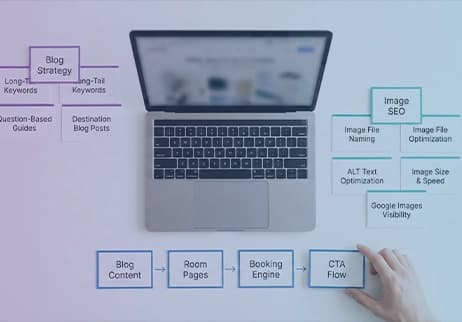
- A content plan focused on high-intent long-tail keywords,
- Guides that answer question-format searches,
- CTAs that connect content → rooms → booking engine.
With hotel photo SEO optimization:
- We optimize file names (hotel-name-room-type-region.jpg),
- Alt text (e.g., “Antalya family resort room – sea view”),
- Image sizes and loading performance.
Hotel SEO Audit and Roadmap
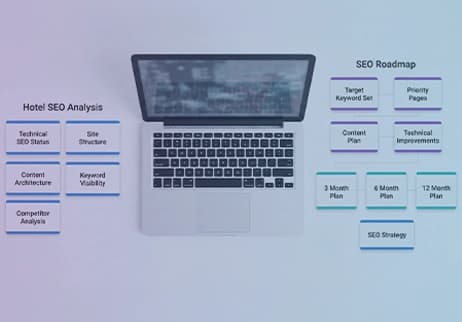
- Your current site’s technical SEO status,
- Content structure and page architecture,
- Your current keyword visibility,
- The SEO performance of competitor resorts & hotels.
Then we prepare a hotel SEO strategy roadmap including:
- Target keyword set,
- Priority pages and content list,
- Technical and content improvement plan,
- A 3–6–12 month Hotel SEO roadmap.
Multilingual Hotel SEO (TR–EN–DE–RU …)
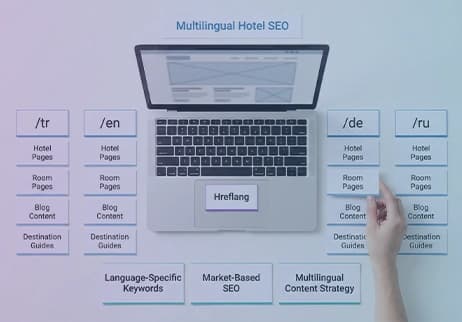
- Separate URL and content structure for each language (domain.com/tr, /en, /de, /ru, etc.),
- Language-specific keyword research,
- Hreflang implementation so Google serves the right language in the right market,
- A strategy for multilingual blog and destination content.
Tourism SEO experience is especially critical for DE (German) and RU (Russian) markets.
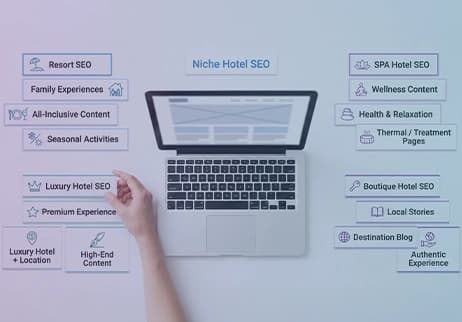
Niche SEO Strategies for Resort, SPA, Luxury, and Boutique Hotels
- Resort SEO,
- SPA hotel SEO,
- Luxury hotel SEO,
- Boutique hotel SEO.
For example:
- For a spa-focused hotel: wellness & health content,
- For luxury: “luxury hotel + region” and premium experience content,
- For boutique: more local, story-driven, high-quality blog & destination content.
Why Hotel SEO with DGTLFACE?
Tourism and Hotel-Focused SEO Expertise
- Works with many hotel & resort projects in Antalya and surrounding regions,
- Understands search behavior across markets (DE, RU, UK, TR),
- Transforms field experience into SEO strategy.
Integrated Approach: SEO + PMS & OTA + Call Center + Ads
- PMS & OTA (OTA management ),
- Online sales optimization ( online sales ),
- Hotel ads management ( ads management , SEM ),
- Social media and content ( social media , SMM ),
- Call center & reservations ( call center , reservation support ),
- Reporting ( reporting , sales conversion )
Measurable, Transparent, and Long-Term SEO Strategy
- Clear KPIs (organic traffic, rankings, reservation & revenue impact),
- Looker Studio dashboards ( Looker Studio ),
- Monthly reports and action plans.
The answer to “How is hotel SEO going?” becomes clearly visible via:
- Ranking charts,
- Organic traffic data,
- Reservation & revenue tables coming from the organic channel.
Micro Layer
SEO for Hotels How Is It Done?
- Hotel and target market analysis,
- Keyword research (region + concept + destination + niche),
- Technical SEO (speed, mobile, structure, schema),
- Content plan (rooms, concepts, destinations, blog),
- Local SEO (Maps, local searches, review management),
- Multilingual architecture (TR–EN–DE–RU),
- Continuous reporting and optimization.
Hotel SEO Keyword Analysis—How Is It Done?
- Region + hotel concept
(e.g., “antalya family resort”, “side all inclusive”, “kemer luxury hotel”), - Market-based searches (German, Russian, English),
- Long-tail questions
(“family hotel recommendation in [region]”, “honeymoon hotel [region]”, “spa hotel [region]”), - Organic visibility of competitor hotel domains,
- “Lifestyle” searches for blog & destination content.
Multilingual Hotel SEO Tips
- Separate page/URL structure for each language (not using auto-translation as the foundation),
- Correct hreflang connections,
- Localization writing—not translation (especially for DE/RU),
- Language-specific technical & content SEO checks.
Blog Strategy for Hotels—What Should It Look Like?
- It should tell not only the hotel, but the region and the experience,
- It should answer frequently asked questions
(“what to do in [region], where to go?”), - Seasonal content (summer, winter, festivals, events),
- Content planning by target market languages,
- Connecting content to the booking journey
(CTA, internal links, package pages).
Hotel Photo SEO Why Does Optimization Matter?
- Many users research hotels via Google Images as well,
- Image file names and alt text should include hotel + region + concept,
- File size, format, and loading speed
are critical for both SEO and user experience.
DGTLFACE Hakkında Questions
See the most common questions about the hotel SEO process at a glance.
Before deciding on direct booking impact, multilingual structure, and visibility strategy, review the hotel SEO FAQ page.
This content is compiled from DGTLFACE’s hotel SEO projects, tourism-specific content & technical SEO documentation, and Google Travel/Hotel initiatives.