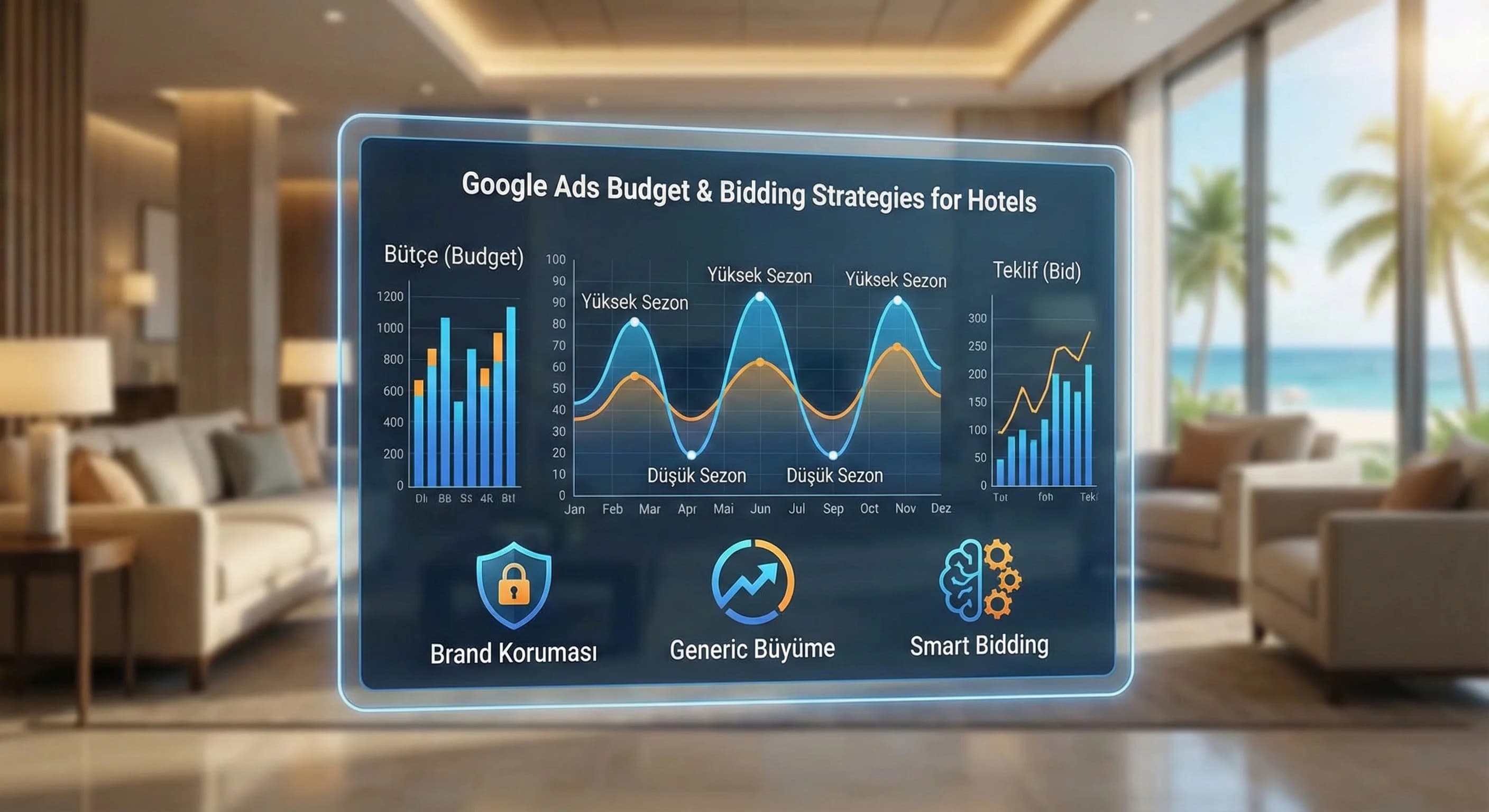
1. How is the Google Ads budget determined?
Clear answer (2–3 sentences): Plan the budget in Google Ads as a monthly target, not as a "daily expenditure"; then calculate the daily average with monthly budget / 30.4. Some days Google may spend more, some days less; however, at the end of the month, the monthly limit optimizes to no more than 30.4 times the average daily budget.
Budget determination formula for hotel (practical)
- •Monthly Ads budget (₺ / €): your targeted spend
- •Average daily budget: Monthly budget ÷ 30.4
- •Target number of bookings (monthly): Monthly budget ÷ target CPA
- •Target CPA (Assumption): “Advertising cost of 1 booking” or “Cost of 1 lead”
What should I do?
- • First write the target KPI (CPA or ROAS?)
- • Then start with the 30-day plan; Decide in 30 days, not 7 days
2. Budget Planning for Hotel (Brand “mandatory”, others “optional”)
The budget plan in the hotel account is not “a little for every campaign”; priority order.
1) Mandatory layer: Brand campaign (protection)
Since brand searches are generally “hot”, the direct booking line may suffer when the budget is cut. Therefore, thinking of the brand as “always on” is like “keep the phone line open” in hotel operations.
2) Growth layer: Generic (volume)
Generic searches; brings more volume but is generally more expensive and more variable. The right move here is; Scaling the budget by reading the market and season.
3) Optional layer: Discovery/Display/Video (awareness and recapture)
This layer provides “extra growth” when measurement and landing are established. Otherwise, it may weaken the brand/generic in a limited budget.
What should I do?
- • Fix Brand's “minimum share” (don't drop it even during the season)
- • Follow Generic separately by market (TR/DE/RU)
- • Optional, turn on only when the measurement is seated
3. Daily/Monthly Budget Model (30.4 rule + overdelivery fact)
Google Ads works with “average daily budget”; This is the average daily spending level for the month. On some days, spending may increase when demand increases; but at the end of the month, it tries to balance the average daily budget in a way that does not exceed the monthly limit calculated based on 30.4 days.
Hotel example (with Assumption)
- •Monthly budget: ₺304,000
- •Daily average: ₺304,000 ÷ 30.4 ≈ ₺10,000
- •Some days: may spend ₺12,000, some days may spend ₺8,000; The goal is to balance it at the end of the month.
What should I do?
- • Don't get caught up in daily expenses and panic; Watch the 7-day trend
- • The “mid-month is over, budget is over” problem is either architecture or targeting breadth
4. Manual vs Smart Bidding Strategies (Manual CPC or Smart Bidding?)
Smart Bidding is the general name of strategies that optimize bids according to the probability of conversion with Google's AI at each auction-time. Target CPA, Target ROAS, Maximize Conversions and Maximize Conversion Value fall into this group.
Manual (control-oriented) when?
- •New account, low data (especially new booking conversion)
- •Landing and measurement not yet established
- •The market is very volatile; You want to collect “clean traffic” first
When is Smart Bidding (results-oriented)?
- •Conversion measurement is solid
- •Enough “conversion cycles” have occurred (time for the algorithm to learn)
- •Your goal is clear: either more conversions or higher conversion value
What should I do?
- • If data is low: first “metering + stable traffic”, then smart bidding
- • If data available: set target CPA/ROAS realistically and tighten gradually
5. Target ROAS / Target CPA and when to use it
Target ROAS optimizes conversion value within Smart Bidding; It estimates conversion value in each auction and adjusts bids to maximize ROAS.
Target CPA asks “how much on average do I want to pay for a conversion?” It takes your goal and adjusts bids accordingly based on the likelihood of conversion.
ROAS or CPA? (hotel decision tree)
- •If booking engine revenue is measured: ROAS makes more sense (value optimization)
- •If lead/call/WhatsApp is dominant: CPA is more practical (cost control)
Technical Note (Locked): Switching to smart bidding with aggressive target when there is no data
Google recommends changing strategy once conversion data and conversion cycle are established; When you introduce a new bid strategy, it is necessary to wait a few conversion cycles for the algorithm to adapt. So setting Target ROAS/CPA too tightly “in the first week” can stifle learning.
What should I do?
- • First 2–4 weeks: “measurement accuracy + stable traffic”
- • Then: gradually approach the target CPA/ROAS (dramatically reduce it)
6. Seasonal Budget Shift (high-low season model for Antalya/Belek/Side)
Demand is fierce at beach resorts: competition increases in high season; In the low season, demand decreases but the opportunity cost differs.
High season (Assumption: Antalya/Belek)
- •Brand: fixed and strong (high cost of hijacking)
- •Generic: volume expansion, but target CPA/ROAS is disciplined
- •Optional: remarketing can be more efficient (increases site traffic)
Low season (Assumption: Side/Kemer/Bodrum breakdown)
- •Brand: still protected
- •Generic: narrows down to more niche segments
- •Optional: not focused on “awareness” but more on “recapture”
What should I do?
- • 6–8 weeks into the season: put budget in “preparation” mode, consolidate measurement
- • In season: protect brand, optimize generic by market
- • When the season is over: learn with reporting (Internal Link: /sem/performance-analysis)
7. New Account vs Mature Account Approach (bid transition plan)
New account (or if metering is newly set up)
- •Priority: accurate conversion measurement + clean traffic
- •Bid: gradual approach instead of aggressive target ROAS/CPA
- •Testing: 14 days of small tests, not major resets
Mature account (if regular conversion is coming)
- •Bid: Optimization is more meaningful with Target CPA/ROAS
- •Budget: market-based scaling (TR/DE/RU separate)
- •Experiment: campaign-based controlled A/B (bid strategy experiments)
What should I do?
- • On the new account: “data first”
- • In mature account: “tighten target + manage budget by market”
8. Download Budget Calculation Pdf Template — SEM / Hotel Budget & Bid Audit Sheet (v1.0)
Download Budget Calculation Pdf Template — SEM / Hotel Budget & Bid Audit Sheet (v1.0)
This audit sheet; It converts your hotel's Google Ads budget into a monthly target → daily average (30.4) model, distributes it to brand/generic/optional layers, and scores the bid strategy selection according to "data maturity". The bottom line is “how much will I spend and what bid will I start with?” It clarifies the question on a single page.
Kim Kullanır?
Hotel sales-marketing manager, GM or agency performance manager.
Nasıl Kullanılır?
- Enter the monthly target budget and target KPI (ROAS/CPA).
- Mark the distribution according to market (TR/DE/RU) and seasonality.
- Choose the bid strategy according to the leaderboard and apply the “top 10 actions”.
Ölçüm & Önceliklendirme (Kısa sürüm)
- ▢ ✅ GA4 conversion installation complete (reservation/lead)
- ▢ ✅ Booking engine revenue measurement verified if available
- ▢ ✅ Phone/WhatsApp/form conversions are measured
- ▢ ✅ The distinction between brand and generic is clear (read separately in the report)
- ▢ ✅ Country/language breakdowns planned at campaign level (TR/DE/RU)
- ▢ ✅ Landing matches net (ad group → single main landing)
- ▢ ✅ Monthly target budget was determined and calculated with a daily average of 30.4
- ▢ ✅ Brand minimum share fixed (protection level)
- ▢ ✅ Bid strategy selected based on data maturity (Manual/Max Conv/TCPA/TROAS)
- ▢ ✅ Weekly reporting rhythm established (Internal Link: /sem/performance-analysis)
PDF içinde: Problem→Kök Neden→Çözüm tablosu + 14 gün sprint planı + önce/sonra KPI tablosu
9. Conclusion: Hotel budget & bid system in 3 steps (summary)
- •Pin Brand (required layer)
- •Choose target KPI (ROAS or CPA?) and plan budget with 30.4
- •Automate as you give: Smart Bidding is powerful but requires a learning cycle
Bir Sonraki Adım
Let's create a budget-bid road map in 1 meeting according to your hotel's market (TR/DE/RU), season and target ROAS/CPA data.