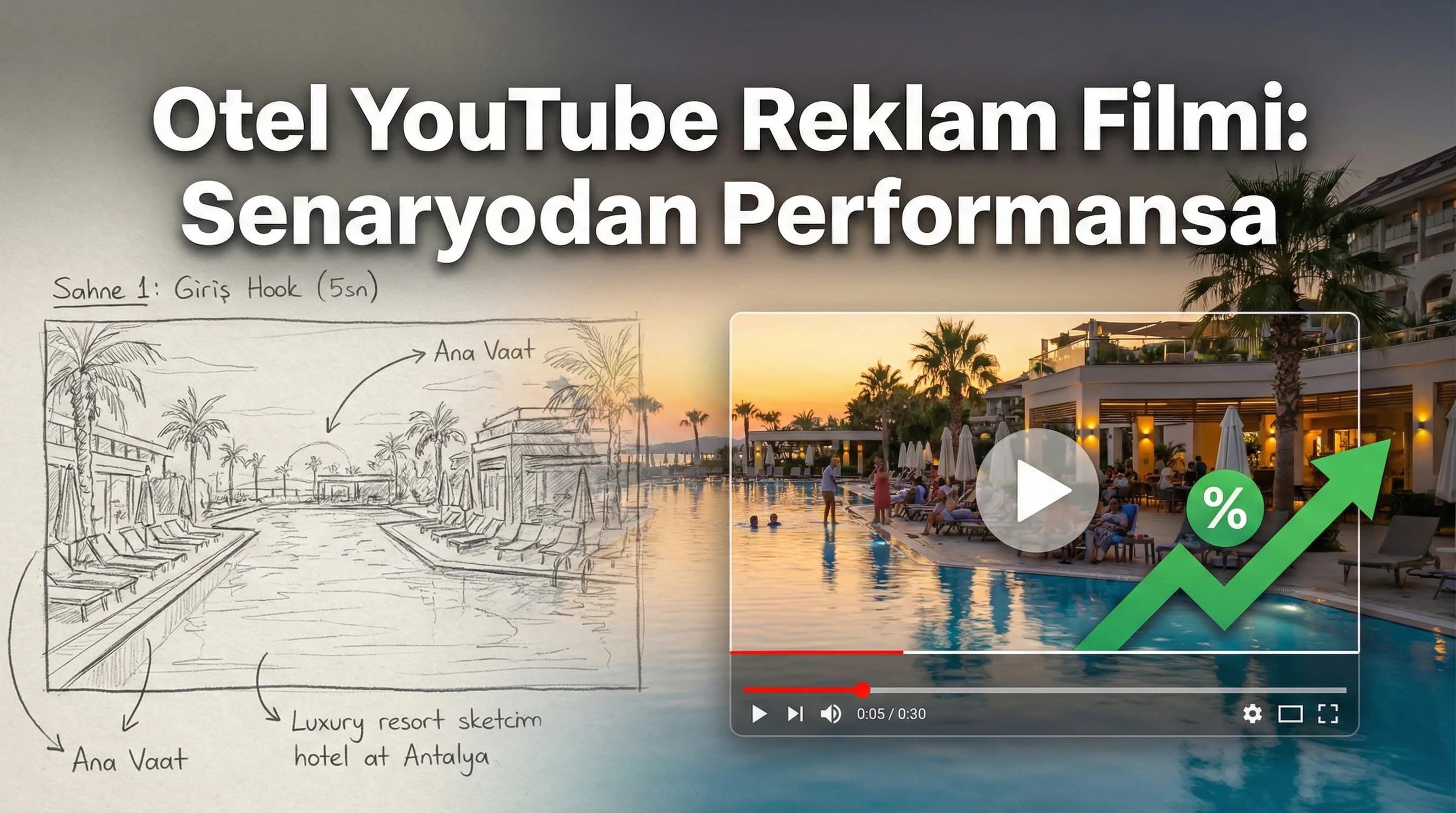
1. Hotel YouTube commercial: script + storyboard for performance
CTA (Primary): Request YouTube Video Script & Storyboard Work — (For hotel teams and agencies that want to connect the script to the performance) Link target: /sem/youtube-advertising-management
2. How to set video destination for hotel? (Brand, Reservation, Experience)
Before writing a script, you have to choose a “one sentence target”. Because if the goal is unclear, the storyboard and scene list swell; The video becomes longer, the message becomes blurry.
1) Brand film target (Upper)
Purpose: to place the destination + concept in the mind. Message: “Who are we, what do we promise?” Example: Family resort in Antalya; Adult concept in Bodrum; Experience/atmosphere in Cappadocia.
2) Reservation target (Lower)
Purpose: to turn the offer/advantage into action. Message: “Why should I book now?” Example: early booking, season opening, special package.
3) Experience target (Mid)
Purpose: the feeling of “I want to experience this.” Message: room + facilities + proof of experience (food, spa, children's area, location).
Mini example (3 hotel types):
- •Resort: family experience + resort scale + amenities
- •City: location + meeting/comfort + speed
- •Boutique: atmosphere + design + story
☑ Mini Check
- • Did I write my goal in one sentence?
- • Have I chosen 1 main KPI that supports the goal (view rate / CTR / lead)?
- • Is my “one promise” clear (concept + advantage)?
What should I do?
- • Select the target as “brand/experience/booking”.
- • Determine video duration and CTA type based on the goal.
- • If the target changes, produce separate variants (don't do everything in one video).
3. How to write a hotel YouTube commercial script?
Screenwriting is not about “listing scenes”; is to establish a story flow + message economy. The structure that works best in a hotel video answers 3 questions in the viewer's mind: 1. What's here? (destination/concept) 2. What good is it for me? (experience/evidence) 3. What should I do now? (CTA)
Story Structure: Introduction – Development – Closing
Introduction (0–5 sec): Hook + promise Development (5–25 sec): proof of room/facility/experience (3 blocks) Closing (end): offer/position + clear CTA
Scenario skeleton (copy-use):
- •Hook sentence: “Experience _____ at _____ destination”
- •3 evidence scenes: (room) → (facility) → (experience)
- •Capa props: “location/transportation/special privilege”
- •CTA: “see prices / get a quote / make a reservation”
☑ Mini Check
- • Is there a “only promise” in the scenario?
- • Don't the 3 evidence scenes repeat each other?
- • Is the CTA text clear and compatible with the landing?
What should I do?
- • Finish the script in 10 lines (extend).
- • Test if you can turn each line into an “image”.
- • Build the CTA from scratch; Don't leave it to the end.
4. What should I show in the first 5 seconds? Hook Design
On YouTube, the first 5 seconds are the “watch/skip” decision moment. Hook in hotels; It is not a random drone image, but a visual move that tells the concept + benefit at the same time.
5 practical templates for Hook
- •Concept clarity: “Family-friendly aquapark resort” in one shot
- •Show the only promise: “Seafront, private beach”
- •Emotion trigger: “Morning view + coffee + silence” (boutique)
- •Quick proof: “Room → pool → restaurant” 3 quick cuts
- •Destination hook: “Antalya / Bodrum” signal + concept
Stage priority (by hotel type):
- •Resort: children's area / pool / amenities before
- •City: lobby + room + location (walkability)
- •Boutique: atmosphere + detail + story
☑ Mini Check
- • Is "hotel type + concept" clear in the first frame?
- • Does Hook work when watched with sound off (subtitles/screen captions)?
- • Do the first 5 seconds carry a single message?
What should I do?
- • Write 3 different hook variants and put them in your shooting plan.
- • To test Hook, plan a 6-second bumper cut.
- • Align the hook and the landing promise exactly.
5. What is storyboard and how is it used in video shooting?
Storyboard; It is the visual plan that directs the shot by planning each sentence in the script frame by shot. The real value of storyboarding in hotels is: • Speeds up the shooting day (which scene, which angle, in what order) • Makes editing easier (cut rhythm, transitions, musical harmony) • Guarantees production of short variants (bumper/shorts/reels clippings)
Storyboard creation steps (net list)
- •Divide the script into 8–12 “shots”
- •For each shot: write scene/action/camera/screen caption/voice memo
- •Distribute the time roughly: 0–5 / 5–15 / 15–30 / closing
- •Add variant plan: 6s bumper, 15s short, 30s main
☑ Mini Check
- • Does each shot have a single “main idea”?
- • Can the shot list be taken (light, space, permission)?
- • Is the bumper/shorts clipping embedded in the shots?
What should I do?
- • Match the storyboard to the “shooting plan” (same set of documents).
- • Block critical scenes (room/pool/restaurant) on the same day.
- • Make a note of safe space for Vertical (9:16).
6. From storyboard to shooting plan: how to prepare a scene list?
Storyboard tells you “what to shoot”; The shooting plan locks down “when, where and how to shoot”. If you don't plan shooting in hotels, even the best scenario will fall apart on the shooting day.
Areas to focus on when creating a scene list
- •Room (general + detail)
- •Pool / beach / view
- •Restaurant / gastronomy
- •spa / wellness
- •Children's areas / activity
- •Lobby / reception
- •Destination texture (literally, “atmosphere”)
| Hotel Type | Stage Priority | Aim | Recommended Duration |
|---|---|---|---|
| resort | pool + children + activity | Clarify “family experience” | 20–30 sec |
| City | location + room + meeting | “comfort + access” | 15–25 sec |
| Boutique | atmosphere + detail + story | “difference + emotion” | 20–30 sec |
☑ Mini Check
- • Does each scene have a “purpose” line?
- • Have I eliminated scenes that show the same thing?
- • Has the shooting day flow (block by block) been extracted?
What should I do?
- • Label scenes with “purpose” (evidence, emotion, CTA?).
- • Block scenes in the same location; reduce waste of time.
- • Don't forget the close-up detail scenes for the edit beat.
7. Text, voice-over and music harmony: connecting “emotion” to performance
In the hotel video, the music gives the “flavor” but it is what carries the message; It is the trio of screen text + voice tone + rhythm. Practical approach for performance: schedule captions/subtitles for viewing with sound off.
3 layer text system
- •Screen title (3–6 words): concept/promise
- •Bottom line (6–10 words): evidence/privilege
- •CTA chip (2–4 words): “See Prices” / “Check Offer”
☑ Mini Check
- • Can the message be understood when watched with the sound off?
- • Does the music fit the cut rhythm?
- • Is the screen text the same as the landing message?
What should I do?
- • Write 3 text layers on the storyboard (adding later).
- • If there is voice-over, apply the 1 sentence = 1 scene rule.
- • Introduce CTA text early; Repeat in the final.
8. Planning according to portrait/square/landscape formats: check croppable from the start
The YouTube main movie mostly runs in 16:9; but for hotels real scale often comes in short formats (reels/shorts/bumper). That's why you should re-establish the "trimable scene" logic in the storyboard.
Safe area and shooting rule
- •Keep the main subject in the center in 16:9 shooting (9:16 crop safe)
- •Paste critical text to bottom/top edges
- •Escape loading 2 objectives in one scene (both room and restaurant)
Bumper and short video derivation (plan first):
- •Bumper (6s): Hook + single evidence + logo/CTA
- •15s short: Hook + 2 proof + CTA
- •30s main: Hook + 3 proof + closing + CTA
☑ Mini Check
- • Is there a “short cut” equivalent for every main scene?
- • Are close-ups sufficient for vertical?
- • Is the CTA and logo placement in the safe area?
What should I do?
- • Make the 6s/15s/30s variant standard in every project.
- • Add extra close-up list for vertical shooting.
- • Cropping ceases to be a “post-editing decision”; embed in storyboard.
9. Shoot day checklist: how do you ensure harmony with production?
Competitor content mostly talks equipment; What makes a difference in hotels is shooting day discipline and loyalty to the storyboard. Here is the practical checklist in hotel production:
☑ Mini Check (Shooting Day)
- • The team has the storyboard + shot list printout.
- • Room/pool/restaurant shooting hours are planned according to the light
- • There is a “silent shooting” plan for crowded areas
- • Vertical close-up list ready
- • Music/rhythm reference forwarded to editor
- • Brand/concept message is the same for everyone in 1 sentence
What should I do?
- • Do a 15-minute “shot briefing” before the shoot.
- • Collect the "right scene" during the shoot, not "too many scenes".
- • Add bumper/shorts submission to your edit brief.
10. Mini section that makes a difference: How does the hotel story (brand story) connect to “sales”?
The “hotel brand story” remains emotional most of the time; But for performance, the story must be connected to "evidence". Example binding methods: • Emotion (atmosphere) → Evidence (room/service) → Action (offer/CTA) • Destination (Antalya/Bodrum) → Concept (family/adult) → Privilege (private beach/spa) This mini bridge collects both views and clicks on the same backbone.
11. Conclusion: Scenario + storyboard is not “video production” but “performance infrastructure”
Hotel YouTube commercial; When its aim is clear, its hook is strong and its scenes are planned, it gives both main film performance and scales with bumper/shorts variants. Storyboard; It speeds up shooting, simplifies editing and improves agency/hotel communication by asking “what will we shoot?” ends his discussion. If you want to standardize the process end-to-end, transfer the production operation to /creative/video-production side; Set up a single production line by connecting short format derivation to /smm/reels-video.
Download Hotel Video Storyboard Template — SEM / Hotel YouTube Commercial (v1.0)
This template allows you to reduce the hotel commercial script to 8–12 shots and turn it into a storyboard. Clarifies the flow of the shooting day; It makes production scalable by planning 6s bumper, 15s short and 30s main film variants from the beginning.
Kim Kullanır?
Hotel sales-marketing team, agency creative strategist, production team (director/editor).
Nasıl Kullanılır?
- Choose the goal (brand/experience/booking) and write a single promise.
- Fill in the following shot lines 8–12.
- For each shot, mark the "crop" column and create a bumper/shorts plan.
Ölçüm & Önceliklendirme (Kısa sürüm)
PDF içinde: Problem→Kök Neden→Çözüm tablosu + 14 gün sprint planı + önce/sonra KPI tablosu
Bir Sonraki Adım
For those who want to lock the script with hooks, scene list and variant plan
Frequently Asked Questions
How to write a hotel YouTube commercial script?▾
What is storyboard and how is it used in video shooting?▾
What should I show in the first 5 seconds?▾
How to prepare a commercial film shooting plan?▾
What is the difference in the scenario for resort, city and boutique hotel?▾
How should scenes be chosen for bumper advertising?▾
What should be taken into consideration when shooting for portrait format (9:16)?▾
İlgili İçerikler