1. How does Google Maps and Local Pack work? (Logic + SERP behavior)
It's practical to think of Google Maps results in three layers:
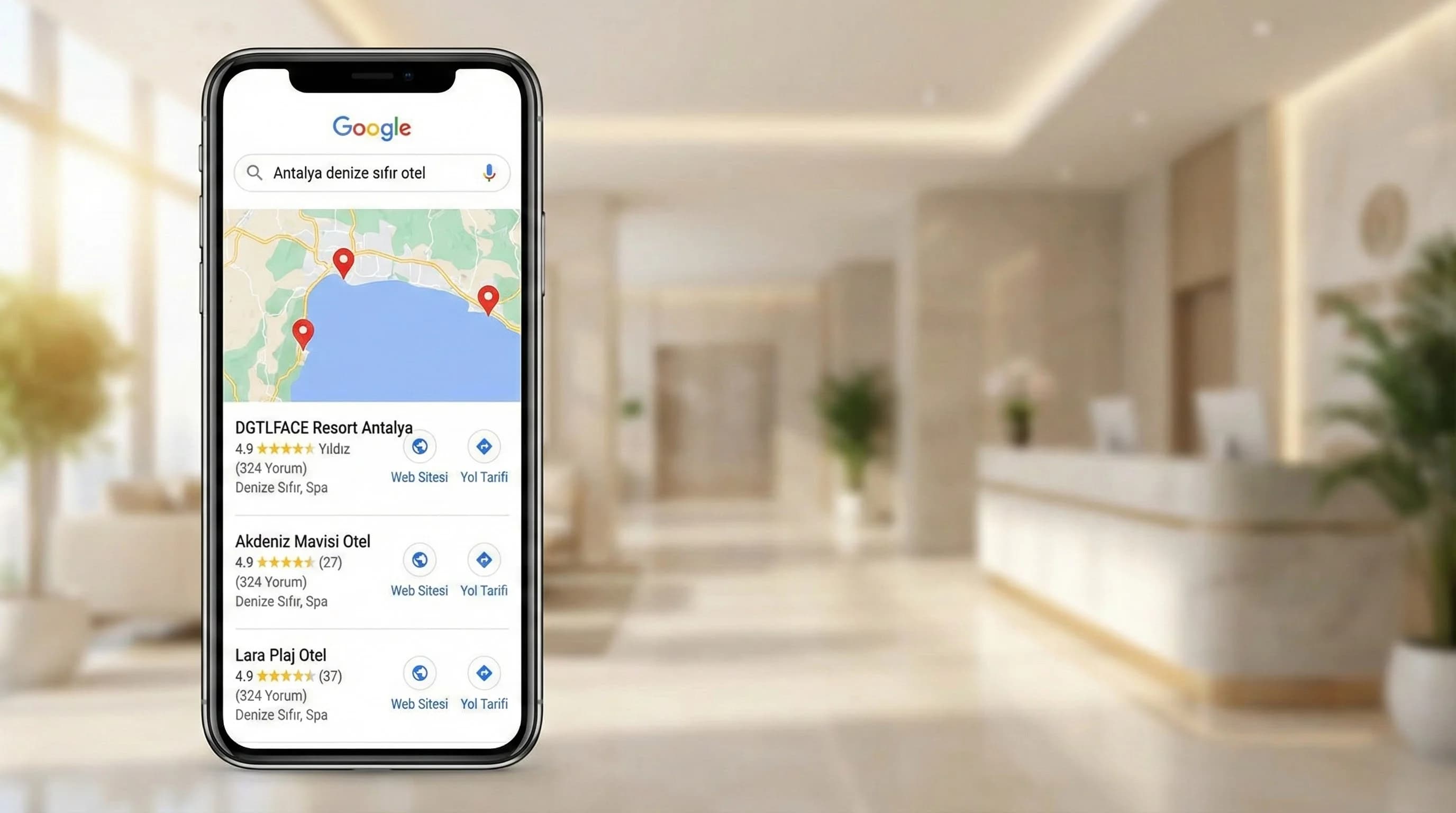
- •Local Pack (3-pack): 3-pack results (most critical area) appearing on the search page.
- •Local Finder: “More locations” screen; The rankings are broader but still competitive.
- •In-Maps results: The impact of filters, category selections and user history increases.
For hotel searches (e.g. “Belek resort”, “Side family hotel”, “Bodrum boutique hotel”), users mostly follow map card → reviews → photos → web/search flow. Therefore, signals on the map side have a direct impact not only on visibility but also on click and conversion rate.
Why is it difficult to appear in Local Pack?
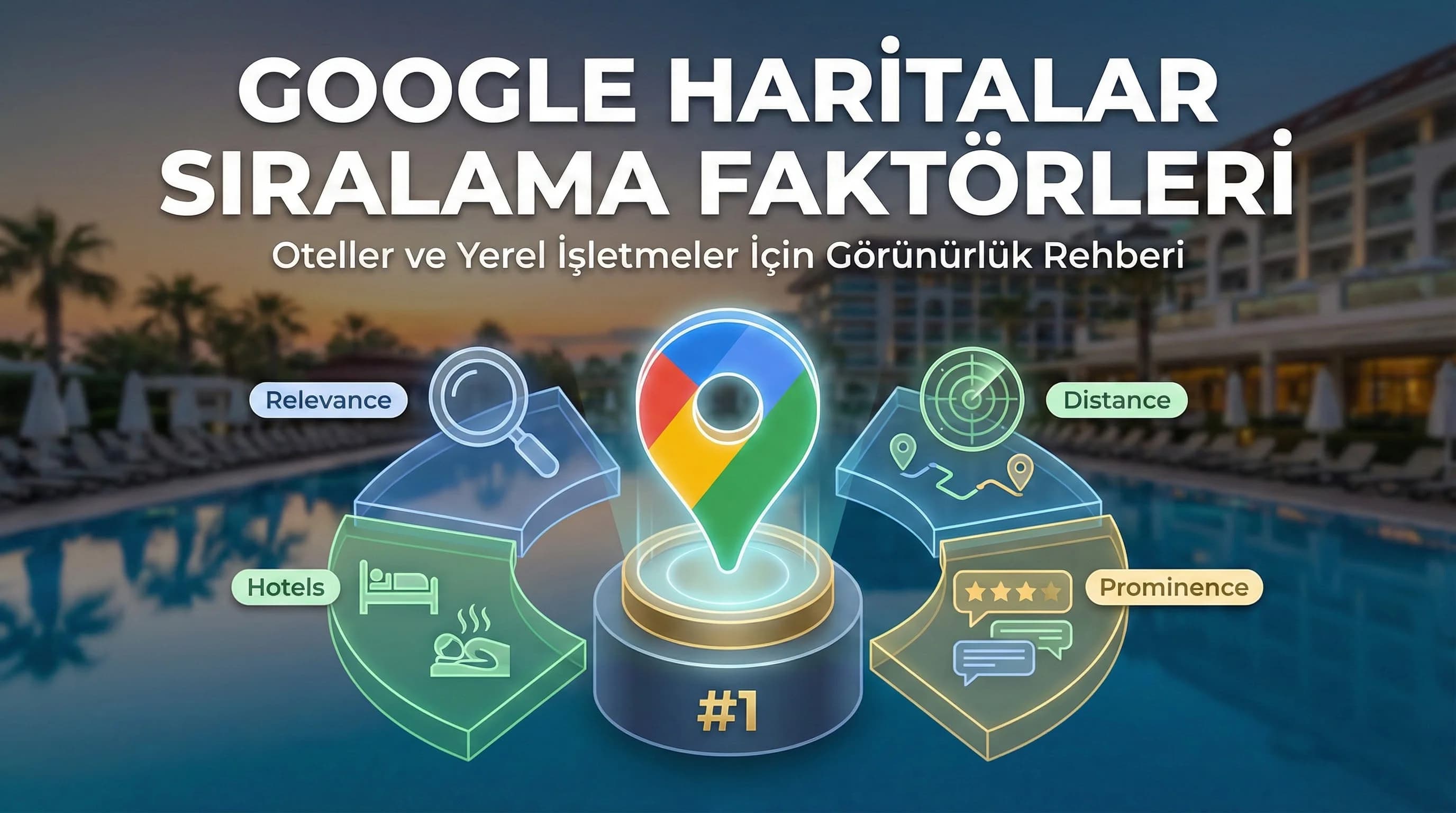
Because Google constructs map results not with the logic of "the best business", but often to show the business that best suits the user's context. This context; It is shaped by location (closeness), search intent (relatedness) and trust/reputation (authority).
☑ Mini Check (Local Pack Basic Check)
- •Do you follow which queries (hotel + region + concept) show Local Pack?
- •Do “web click / route / search” actions appear on your map card?
- •Have you compared the difference between you and the first 3 results (comment, category, content)?
What should I do? (3–6 actions)
- •Identify the 10 main queries that users are searching for (e.g. “Kemer beachfront hotel”).
- •Take note of 3–5 competitors appearing in Local Pack for each query (category/comment/NAP/site).
- •Evaluate GBP content quality + comment profile + NAP + site speed together.
- •Make the “Local SEO NAP consistency” check a process, not a one-off.
2. What are Intimacy, Relatedness and Authority? (Distance–Relevance–Prominence)
Google Maps ranking factors are practically a combination of these three main concepts. Many teams focus on just one (e.g. “get more reviews”), but the outcome remains unbalanced.
Proximity (Distance): “How close are you to the user?”
Proximity is especially strong on mobile. When a user in Antalya types “hotel near me,” map results often highlight the closest available options rather than “best brand.” Although the things to do here seem limited, there is a critical detail for hotels: correct pin location and correct address standard.
- •If the hotel's entry point/pin is incorrect, your "proximity" signal will be disrupted.
- •Multiple entrances (main gate/car park) and wrong pin also degrade the route experience.
Relevance: “How suitable are you for what is sought?”
Relatedness takes shape in GBP's category–description–features–services fields and user signals. Ex. Concepts such as “family hotel”, “spa resort”, “seaside”; It is strengthened by the right category/attribute match and content language.
- •If a hotel is in the “Resort Hotel” category but does not include a spa, kids club or aquapark in the description/attributes; query matching becomes weaker.
- •Most of what we call “Hotel local pack optimization”; This is to clarify the match.
Authority: “How well known and trusted are you?”
Authority is not just the number of comments. Comment quality, replies, external mentions, local citations, brand searches and web signals work together. If seasonal fluctuation in hotels (review explosion in high season) is not managed well, "stability" may be lost.
☑ Mini Check (3 Cores)
- •Are the pin and address standard?
- •Do the category + description + attributes match the target queries?
- •Do you support authority with NAP + web + mention, not just comment?
What should I do?
- •Proximity: verify pin/address accuracy; clarify the entry point.
- •Relatedness: map categories/attributes based on target queries.
- •Authority: design comment management and local quotes as a “process”.
- •Watch all three: optimizing a single signal is often not enough.
3. Google Business Profile signals: Category, content and freshness
Google Business Profile is like the “dashboard” of map visibility. The most important difference of GBP for hotels is; It should not be filled out once and left, but should be updated regularly.
Technical note: Having your Google Business Profile verified and updated at least 1–2 times each month (post, photo, Q&A, feature update) is a strong signal for stability.
1) Correct category selection (primary + secondary)
The primary category is “what race are you in?” determines the question. Hotels often compete in categories like “Hotel/Resort Hotel/Boutique Hotel,” while secondary categories reinforce the concept (spa, restaurant, event space, etc. based on the actual presentation of the business).
2) Description, features and services: “Relevance engine”
The description field is not for keyword stuffing; It is to explain the concept-location-value proposition. Ex. The expression “family-oriented resort in Side”; It carries an intent signal to both the user and the system. If the amenities (pool, spa, kids club, beach, parking) and services (transfer, event, restaurants) are complete, the relatedness increases.
3) Photography and media: the “behavioral signal” that increases clicks
Photo quality in hotel profiles pushes the user to the “route/search/web” action. It is especially effective to update photos early/mid-season, add new concepts, and clarify the room/experience/restaurant distinction.
4) GBP posts and update discipline
Posts (campaign, event, announcement) create interaction on the map card. The target here is not spam, but an "active business" signal.
☑ Mini Check (GBP Consolidation)
- •Is GBP verification ok?
- •Is the primary category correct; Do secondaries support real service?
- •Are the attractions (spa, children, beach, etc.) complete?
- •Is there a routine of 1–2 regular updates per month?
What should I do?
- •Reorganize the category/attribute map based on target queries.
- •Update the photos with the “room/experience/food and beverage” folder logic.
- •1–2 posts per month: focused on business updates, not campaigns.
- •Manage the Q&A area: add answers to frequently asked questions.
5. NAP consistency and local citations: The backbone of visibility
“Local SEO NAP consistency” (Name–Address–Phone) remains messy in most businesses: different phone numbers in different directories, old address, wrong web link… This makes it difficult for Google to create a “unique business identity”.
Why is NAP so effective?
Because NAP; It is like a verifiable identity signal of the business in the map ecosystem. Particularly in multi-channel hotels (OTA profiles, agency pages, event platforms, local directories) inconsistency grows rapidly.
Where do local citations appear?
- •Local directories / city guides
- •Tourism portal listings
- •Off-map platforms (menu/event/booking listings)
- •Brand mentions and press content
Example: If the phone number of a hotel in Kemer is different on the website, different in GBP, different in a local directory; The “trust” signal is broken. This may reduce ranking stability, especially for competitive Local Pack queries (e.g. “Kemer resort”).
☑ Mini Check (NAP Check)
- •Is the business name in the same format everywhere (no abbreviation differences)?
- •Does the address have the same spelling standard (street/neighborhood/district)?
- •Is the phone number individual, switchboard or call center (net)?
- •Is NAP the same in at least 10 critical directories?
What should I do?
- •Create a single “NAP master” document (official format).
- •Prioritize critical indexes (impact × effort).
- •Clean up old/incorrect records, standardize new records.
- •Make NAP monitoring a routine at least quarterly, not monthly.
6. Website and technical SEO impact: Speed, mobile and structured data
Google Maps rankings are not “GBP only”. website; It is both an authority and “last click” conversion area for the hotel. Moreover, it is a fast and mobile compatible site; It prevents traffic coming from the map from being lost.
1) Mobile speed and page experience
Map traffic comes mostly from mobile. If the site is slow, the user will “back” and Google will see this behavior. Core Web Vitals, image optimization and critical CSS/JS management; Strengthens map transformation.
2) Local landing pages (location + concept)
Instead of a single home page of the hotel, a landing structure suitable for local intent (e.g. “Family resort in Belek”, “Side spa hotel”) supports both organic and map performance. The goal here is not spam; It is a real service/concept expression.
3) Schema and entity binding (AIO requirement)
On the AIO side, it is necessary to meaningfully link entities such as "Google Business Profile, reviews, NAP, distance, relevance, prominence" in a single content. website; It gives a “clear” signal to the search engine with schemes such as Organization/LocalBusiness/Hotel (as the case may be) and FAQ/HowTo.
4) Map embed and contact page
Accurate NAP, map embed, opening hours and referral links on the contact page; Increases user confidence. Embed alone is not a “ranking hack”; but provides consistency and user experience.
Frame that makes the difference: GBP + NAP + Site triangle (hotel example)
Competitor content often mentions “global local SEO”; The most critical difference in the hotel case is that these three areas are managed simultaneously:
- •GBP: category/attribute/media/current
- •NAP: unique identity on all platforms
- •Site: speed + location/concept landing + schema + conversion flow
Consider a boutique hotel in Bodrum: GBP is great, but if NAP is messy and the site is slow, visibility will be fleeting. Or if NAP is perfect but GBP content is poor, you will experience a loss of relevance. Optimizing the triangle together is the most practical and sustainable way of “hotel local pack optimization”.
☑ Mini Check (Site + Local Pack Bridge)
- •Is there a mobile speed target (especially blog/landing)?
- •Is the content original in local landings (location/concept)?
- •Is NAP + embed + CTA clear on the contact page?
- •Has an “answer-oriented” structure been established with Schema/FAQ/HowTo?
What should I do?
- •Speed up the pages from which map traffic comes (first screen focused).
- •Plan location/concept landing structure (real value, not spam).
- •Reduce friction in the contact + booking flow (mobile UX).
- •Think of local SEO as integrated with the site, not as a “single channel”.
7. Things to do in the first 30 days: Hotel sprint for Local Pack visibility
This section gives the “immediately applicable” plan as per the SXO requirement. Goal: Visibility stability and measurable actions within 30 days.
Week 1: Basic verification and measurement
- •GBP verification, category/attribute check
- •NAP master document creation
- •Map KPI baseline: views, route, searches, web clicks
- •Competitor 3-pack benchmark (Antalya/Belek/Side/Kemer/Bodrum sample queries)
Week 2: Content and trust signals
- •Photo set update (room/experience/food and beverage)
- •GBP post routine (1–2 content)
- •Comment retrieval flow: trigger after check-out
- •Negative review response standard
Week 3: NAP and citations cleaning
- •NAP standardization in 10–20 critical directories
- •Correction of old records
- •Website contact page NAP + embed + CTA
Week 4: Site speed + landing + schema
- •Mobile speed improvements (image/JS)
- •Location/concept landing draft
- •FAQ + HowTo + (if applicable) LocalBusiness/Hotel schema plan
- •30-day KPI comparison and next 90-day roadmap
☑ Mini Check (30 Days Sprint Release)
- •Has the baseline KPI been recorded?
- •Has the GBP update routine started?
- •Is the NAP standard achieved in 10+ directories?
- •Has the site mobile speed been improved?
8. Conclusion: Map visibility is a system, not a “one move”
Google Maps ranking factors; It requires managing the trio of proximity-relationship-authority through GBP + comment + NAP + site. The difference in the approach in this guide is that it proceeds with the “triangle” model in the hotel/tourism context: keeping the system in balance rather than polishing a single area. Once you establish a regular update routine and measurement discipline, Local Pack visibility becomes more stable and connecting map traffic to reservations becomes easier.
9. Download Google Maps Optimization Checklist — SEO / Local SEO (v1.0)
Download Google Maps Optimization Checklist — SEO / Local SEO (v1.0)
This checklist; It collects the basic signals (GBP, reviews, NAP, site) that affect the Google Maps/Local Pack visibility of hotels and local businesses on a single page. It extracts the current situation in 30 minutes and then turns it into actionable actions with a 14-day sprint plan. So “what do we do?” The question becomes clear and KPIs become measurable.
Kim Kullanır?
Hotel owner/GM, sales-marketing manager, digital team or agency project manager.
Nasıl Kullanılır?
- Fill in the checklist (current status + missing signal).
- Select the top 3 priorities from the problem–root cause–solution table.
- Implement the 14-day sprint plan; Compare KPIs on day 1 and day 14.
Ölçüm & Önceliklendirme (Kısa sürüm)
PDF içinde: Problem→Kök Neden→Çözüm tablosu + 14 gün sprint planı + önce/sonra KPI tablosu
10. Table: Local Pack Signal Matrix (GBP / Reviews / NAP / Site) – KPI & Quick Action
Bir Sonraki Adım
Create a clear signal-based action plan for hotels and local businesses that want to increase map visibility.
Frequently Asked Questions
What are Google Maps ranking factors?▾
How does my hotel rank higher on Google Maps?▾
What do closeness, relatedness and authority mean?▾
Do reviews affect local rankings?▾
What is NAP consistency and why is it important?▾
How often should I update Google Business Profile?▾
Does adding a map embed increase rankings?▾
What should be considered in multi-location businesses (chain hotels)?▾
İlgili İçerikler
4. Reviews and rating: Review strategy (hotel focused)
Comments affect both authority and conversion sides in Local Pack. Review management in hotels is not “just points”; Seasonal operation is intertwined with service quality and expectation management.
Number of comments or quality of comments?
Both are important, but balance is critical:
Comment replies: Invisible lever on the “Prominence” side
Not a defense against negative comments; Providing solution-oriented, short and consistent responses increases the "active" and "reliable" perception of the business. Ex. For a resort in Belek, linking the "check-in rush" complaint with process improvement affects both the user and the algorithm.
Comment receiving system (ethical and sustainable)
☑ Mini Check (Review Management)
What should I do?