1. Comment management: trust + Local Pack visibility
2. The role of comments and ratings in local rankings (reviews, rating, recency, responses)
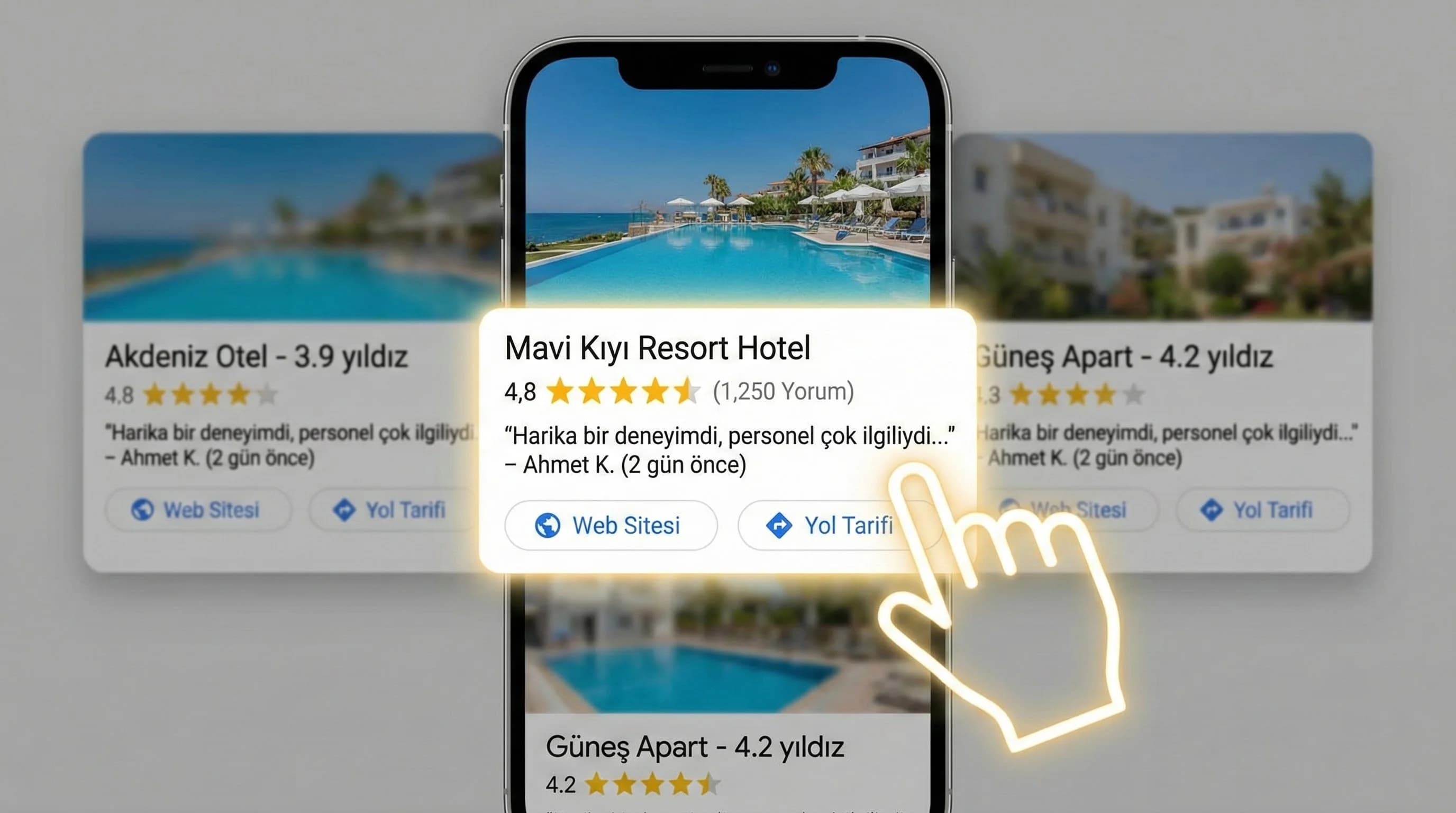
Reviews affect two things at once for hotels: 1. Perception and trust: The guest asks “is this hotel trustworthy?” Answers the question from the comments. 2. Behavioral signal: User stops at map card, enters comments, clicks/searches/requests route. These behaviors can indirectly produce a quality signal that supports visibility. Let's clarify the four basic signals in this section:
1) Number of comments (volume)
“Google review count importance” is simple in hotels: zero or very few reviews weaken the card. But “many comments” alone are not enough; It must combine with quality and freshness.
2) Average score (rating)
A high score lowers the barriers at decision time. In particular, it is often emphasized in many analyzes that a 4.5+ average score is associated with higher clicks and stronger booking intent (think “usually/in most analyzes” rather than claiming an exact number).
3) Freshness (recency)
The hotel experience fluctuates seasonally; That's why "freshness of recent comments" is a critical signal. A regular flow of reviews over the last 90 days increases both user trust and the perception of an “active business.”
4) Responses
The answers are not just “being nice”; It shows the business' problem-solving capacity and brand tone. Bad comments without a response weaken the trust signal on the card; Quick and empathetic responses reduce the risk.
☑ Mini Check (Signal Health)
- • Is there a steady stream of comments over the last 30–90 days?
- • Is the average score “stable” or is there fluctuation?
- • Are negative reviews responded to within 24–72 hours?
- • Is there consistent brand tone and solution language in the responses?
What should I do? (3–6 actions)
- • Track comments in 4 KPIs: number, rating, freshness, response rate.
- • Construct “getting comments” as a process, not a campaign (weekly target + responsible).
- • Set a rapid response SLA on negative reviews (24–72 hours).
- • Use a simple quality score to measure response quality (see table recommendation).
3. Sources other than Google reviews (Booking, Expedia, etc.) and indirect effects
Google Maps ranking is not directly calculated by “Booking score”; But in the real world, there are indirect effects on guest perception and brand demand. That is, comments on channels such as Booking/Expedia; • It can increase the guest's trust and increase brand search, • may affect website click-through and call/booking behavior, • It can indirectly contribute to local visibility by strengthening the overall picture of “reputation”. The ideal approach on the hotel side: seeing the review ecosystem as “multi-source reputation management” without restricting it to a single channel; but it is about positioning the role of each resource correctly.
Multi-source reputation management: practical framework
- •Google: Map card + Local Pack + direct search behavior
- •OTAs (Booking/Expedia): Decision support and purchasing platforms
- •Tripadvisor etc.: Experience-oriented reference and comparison
☑ Mini Check (Ecosystem)
- • Is there a significant difference between Google and OTA scores?
- • Is there a quick response to user questions (Q&A) on Google?
- • Are the top complaints (e.g. cleanliness, check-in) the same across all channels?
What should I do?
- • Create a single “reputation dashboard”: Google + OTA + web feedback tracked together.
- • Close the most recurring problems with operational feedback (quality loop).
- • Recognize that there are different expectations across different channels; adjust the response tone accordingly.
5. How do hotel reviews affect local SEO?
As per AEO requirement, this section proceeds in question format with clear answers.
Do reviews affect local rankings?
Yes; Reviews can strengthen the hotel's trust signal, click and engagement behavior, and the card's "active business" perception. In hotels, especially the trio of score, freshness and response quality; It speeds up the guest's decision and tends to increase map actions.
Is the number of comments or the average score more important?
There is no single truth; The best approach is to strike a balance: • The number of comments provides “presence and volume”, • Score average provides “persuasion”, • Freshness and response discipline provide “stability”. Where this balance is disrupted (many comments but low scores; high scores but very few comments; stale comments), performance may suffer.
☑ Mini Check (Balance)
- • Is the comment volume sufficient?
- • Does the average score give confidence at the time of decision?
- • Is the comment deadline near?
- • Is the response rate high?
What should I do?
- • Monitor “Comment KPIs” weekly and set monthly targets.
- • Close low scoring themes with operational improvement.
- • Do not cross ethical boundaries when increasing comment volume (no incentives/rewards/fake comments).
6. Response to positive and negative comments (professional, untemplated but systematic)
Comment response carries two extreme risks: • If it is completely stenciled, it will look robotic, • The process cannot be sustained if it is not fully personalized. The right solution: “SOP + skeleton + personal touch” model.
The skeleton of a good answer (4 steps)
- •Thank you + name/context (personal touch)
- •Response to specific topic (not general sentence)
- •Solution/improvement or confirmation (confidence)
- •Return invitation (contact/re-welcoming)
Response sample logic to bad comments
The aim of crisis commentary is not to "be right"; is to reduce risk and give confidence to outside readers. “How should I respond to bad reviews as a hotel?” The shortest answer to the question: empathy + clear action + communication channel.
☑ Mini Check (Response Quality)
- • Does the response include empathy?
- • Does it address the specific problem?
- • Is there a solution step or follow-up?
- • Is the brand tone consistent?
What should I do?
- • Set a 24–72 hour response SLA.
- • Use an answer skeleton, but add 1–2 personal details to each answer.
- • Take crisis comments into the escalation flow (GM/quality officer approval).
| Comment type | Bad answer example (why it's bad) | Example of good answer (why it is good) | 1 sentence “improvement rule” |
|---|---|---|---|
| Positive comment | "Thanks." (non-specific, robotic) | “Thank you for your nice comment. We are glad you were satisfied with the breakfast. We would like to welcome you again.” (specific + invitation) | Add 1 detail: touch on the topic the guest is talking about. |
| negative review | “We don't do that.” (defensive language, increases risk) | "We are sorry for the situation you are experiencing. We are checking and improving the issue you mentioned with our team. You can contact us to resolve the details." (empathy + action + channel) | Instead of defense: empathy + clear action + communication channel. |
| Crisis commentary | “Your comment is unfounded.” (increases tension, loss of trust) | "We attach great importance to this feedback. We immediately investigated the issue. If you can share the reservation details with us without sharing them publicly, we will respond within 48 hours." (serious + safe channel + follow) | Do not engage in public discussion; Move it to a secure channel and promise to follow up. |
7. How should I, as a hotel, respond to bad reviews? (Voice compatible mini format)
Short format as per Voice requirement:
Short answer format (3 sentences):
- •“Thank you for your feedback, we are sorry for the situation you are experiencing.”
- •“We are checking and improving the issue you mentioned with our team.”
- •“To resolve the details, you can contact us via: (phone/email).”
Assumption: Your communication channel and responsible team structure are ready.
What should I do?
- • Take these 3 sentences as basis; Always include “specific topic”.
- • Do not use defensive language; Focus on convincing the outside reader.
- • Do not share personal data/booking details.
8. Guest experience → review → local SEO cycle (quality system)
Comment management yields best results when tied into the “quality loop”: comments are not just responded to, but used to improve the operation.
How does the loop work?
- •Guest experience → review content (themes)
- •Theme analysis → operation action
- •Operation action → next comment quality
- •Response discipline → brand trust
- •Trust + clicks → local visibility
☑ Mini Check (Loop)
- • Are comment themes reported monthly?
- • Is action taken for the 3 most recurring problems?
- • Is post-action change (score/comment tone) monitored?
What should I do?
- • Create a monthly “review themes” report (cleanliness, check-in, food, room).
- • Designate 1 responsible + 1 corrective action for each theme.
- • Compare “before/after” KPIs within 90 days.
9. Technical note: Fake reviews, comment buying and policy risk
As per the Technical SEO note, let's be clear: Although practices such as comment buying, fake comments, mass/coordinated comment manipulation may seem attractive in the short term, they create Google policy risks and loss of trust. The most sustainable way for hotels; natural comment flow and professional response SOP.
☑ Mini Check (Risk)
- • Do comment solicitation messages contain “encouragement”? (avoid)
- • Is there an abnormal increase in comments on the same day?
- • Have uniform comments with similar texts increased?
What should I do?
- • Strengthen “natural review” processes (post check-out).
- • Quickly do an internal audit on waves of questionable comments.
- • Prioritize brand trust over speed.
10. Mini section that makes a difference: Linking comment management to the “SEO signal”
Competing content often describes comment management as CRM/reputation management; The difference in this guide is that we consider comments together with local ranking components: rating + reputation + responses + behavior signal. When you proceed with this framework, the “response to bad comment example” is not just a text; It becomes a part of the process that affects visibility and conversion performance.
11. Review Response Templates & Reputation Management Checklist (Download)
Download Review Response Templates & Reputation Management Checklist — SEO / Comment Management (v1.0)
This asset; It enables hotels to standardize review responses without becoming robotic, manage crisis reviews with the correct escalation flow, and streamline the review process ethically. It marks the deficiencies with the current status checklist in 30 minutes, and then creates a consistent brand tone within the team with ready-made response skeletons. The result: higher confidence, better response discipline and a more stable local visibility signal.
Kim Kullanır?
GM/hotel manager, sales-marketing, guest relations, agency social/reputation manager.
Nasıl Kullanılır?
- Fill out the checklist and mark the 10 most critical vulnerabilities.
- Adapt response templates to your brand tone (1 time) and link to the SOP.
- Apply for 30 days; Compare score/freshness/response rate KPIs.
Ölçüm & Önceliklendirme (Kısa sürüm)
- ▢ ✅ There has been a steady stream of comments over the last 90 days
- ▢ ✅ 24–72 hour SLA applied to negative reviews
- ▢ ✅ Response tone depends on single standard
- ▢ ✅ There is an escalation flow for crisis comments
- ▢ ✅ No fake/promoted review enforcement (policy risk reduced)
- ▢ ✅ Comment themes are reported monthly (linked to operational action)
PDF içinde: Problem→Kök Neden→Çözüm tablosu + 14 gün sprint planı + önce/sonra KPI tablosu
Bir Sonraki Adım
Let's analyze your comment profile (score/freshness/response) and create a 30-day action plan together.
Frequently Asked Questions
How do hotel reviews affect local SEO?▾
Is the number of comments or the average score more important?▾
How should I respond to negative comments?▾
How to ask for natural reviews from guests?▾
Does buying fake reviews work?▾
İlgili İçerikler
İlgili Yazılar
4. How to ask for natural reviews from guests? (comment getting strategy)
“How to ask for natural comments from guests?” The answer to the question is an ethical and sustainable flow. The best results in hotels generally follow three rules: right time, right channel, low friction.
Review flow (example for hotel)
Assumption: You can use CRM or a simple automation tool. Otherwise, you can proceed manually through the "weekly output list".
3 golden rules in requesting comments
☑ Mini Check (Receiving Comments)
What should I do?