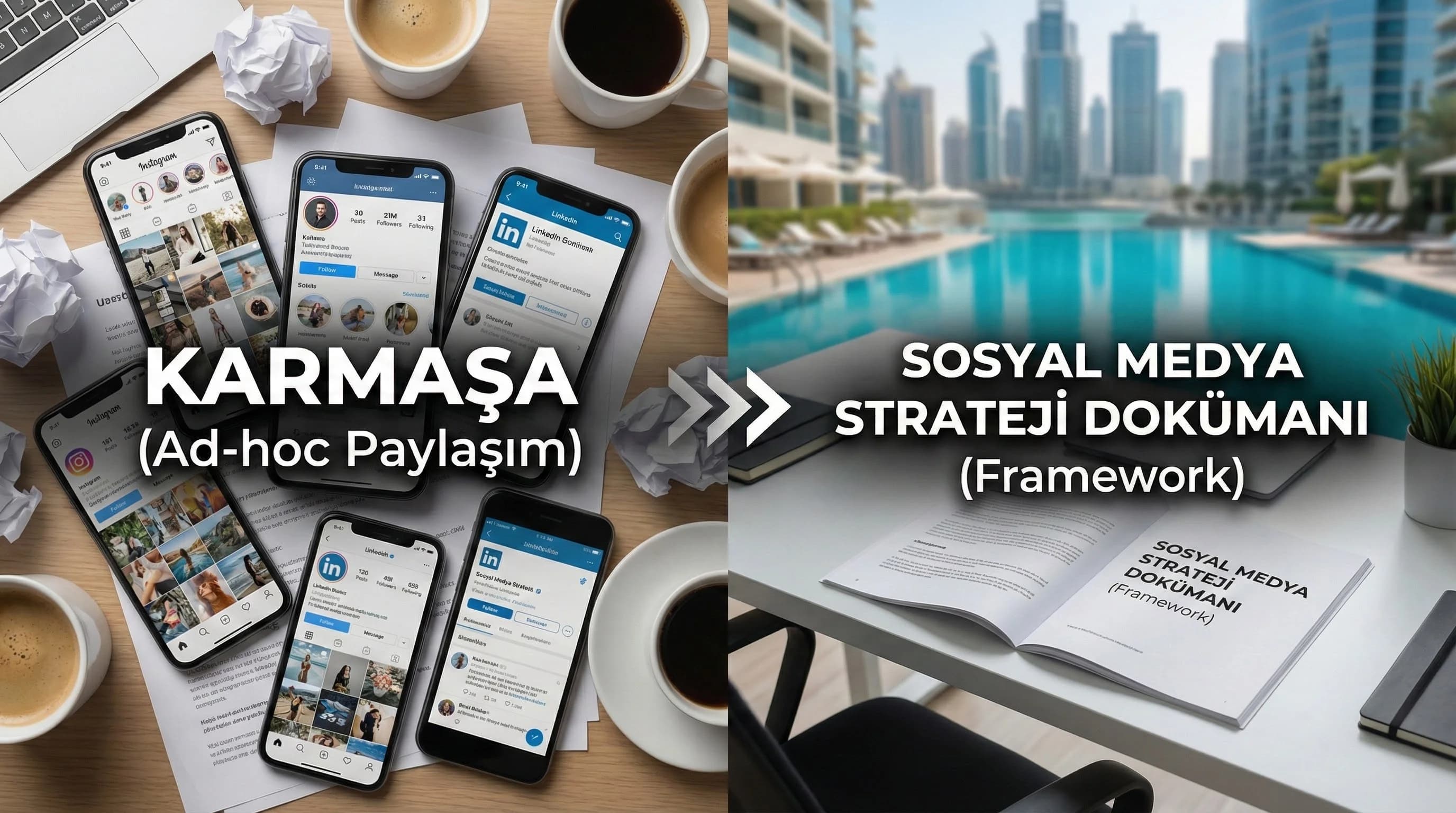
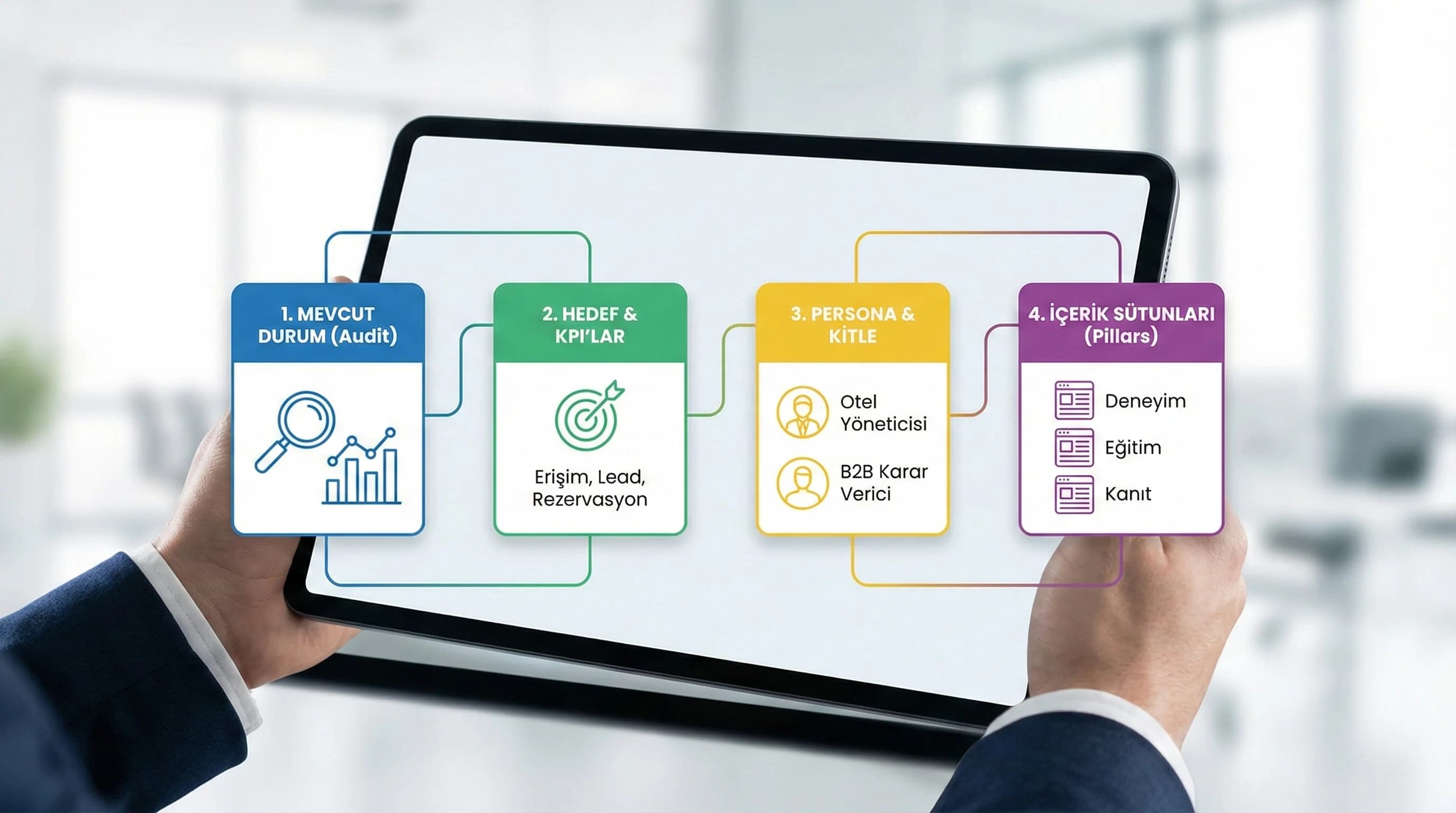
1. 1) Current Situation Analysis (Audit) – “Where are we?”
Audit, “what did we share?” It is not just a list; channel health + content performance + audience signal + competitor benchmarking. Audit in hotel groups (e.g. in buildings with seasonal campaign pressure on the Antalya–Belek–Side line); It also includes the impact of season, market and offer changes on social performance. In B2B/service brands, the audit asks “which type of content triggers which intent?” It should answer the question.
Which titles should I look at in Audit?
- •Channel inventory: Instagram, LinkedIn, X, YouTube, TikTok (if available) + community channels
- •Content inventory: format (carousel/reel/video), topic (pillar), offer (campaign), language/locale (such as TR/EN/DE/RU)
- •Performance: reach, engagement rate, saves, shares, clicks, watch time, profile actions
- •Conversion signal: web clicks, form/WhatsApp/search referrals (if tagged)
- •Competitor benchmark: message positioning, delivery frequency, format mix, “most engaged themes”
Mini example (hotel)
A resort in Kemer announces its "early booking" campaign only with visual posts; There is no real or story flow. Seen in Audit: high reach but weak click/booking signal. Solution: reconstruct the same campaign with a “3-stage” content system (teaser → proof/social proof → clear CTA).
☑ Mini Check (Audit quick check)
- •Why did the top 10 content perform well in the last 90 days? (format + theme + hook)
- •Are there any common mistakes in the top 10 worst pieces of content? (message ambiguity, lack of CTA, target audience mismatch)
- •Is there a single “definition of success” by channel? (like IG = saving/DM; LinkedIn = lead/meeting)
- •Is there a format/theme that your competitors “don't have” but produces results?
What should I do?
- • Collect 14 days of content and performance data into a single table.
- • Categorize the best content with “theme + format + hook” tags.
- • Choose from 3 formats and 3 theme benchmarks from competitors.
- • Turn audit outputs into a one-page “findings & recommendations” summary.
2. 2) Goal and KPI Definition – “Where are we going, how will we measure?”
The heart of the strategy document is the set of objectives and KPIs. “Increase in followers” is not a goal, it may not even be an indicator of results. Social media for the hotel; It is considered together with reservation, call center, offer pages and brand trust. On the B2B/service side, since the sales cycle is long, the KPI set should be established in the "microconversion → lead → meeting → offer" chain.
How do I set KPIs and targets?
SMART goal examples
- •Hotel: “Increase the number of users coming to the web from organic social traffic by X% in Q2” (Assumption: X% target is clarified based on internal data)
- •B2B: “Creating N qualified meeting requests per month via LinkedIn”
Example KPI set (core)
- •Awareness: reach, video views, brand search trend (Assumption: Tracked via Search Console/GA4)
- •Consideration: save, share, profile click, site click
- •Conversion: form/WhatsApp/phone click, number of leads, CPA/CPL (Assumption: if tag/UTM)
☑ Mini Check (Target-KPI compliance)
- •Can the measurement of each target be reported “on one screen”?
- •Are the KPIs appropriate to the nature of the channel? (IG save ≠ LinkedIn lead)
- •Is there a 90-day baseline? (Assumption: first 30 days baseline)
- •Is the KPI responsible and reporting rhythm written?
What should I do?
- • Write goals in 3 layers: Business goal → Marketing goal → Channel KPI.
- • Simplify KPIs with the “1 main + 2 support” rule.
- • Add the measurement source (GA4, platform insights, CRM).
- • Create a 90-day baseline and set a realistic target band.
3. 3) Target Audience and Persona – “To whom, what decision are we facilitating?”
Persona is not just demographics; needs, objections, decision criteria and content consumption behavior. Persona on the hotel side; It varies with parameters such as domestic/foreign market, family/couple, season and budget. On the B2B/service side, personas are mostly “role-based”: GM, sales-marketing manager, digital marketing officer, agency owner, etc.
How should I write the Persona in the document?
- •Goal/business question: “What decision will he make?”
- •Pain point: “Why is it having difficulty?”
- •Objections: “What does it matter?”
- •Content triggers: “What format/evidence convinces?”
- •CTA behavior: “DM, form, phone?”
Hotel persona mini example (TR-wide)
- •Persona: “Sales & Marketing Manager (hotel group)”
- •Pain point: “There are too many campaigns during the season; message consistency is disrupted.”
- •Objection: “Agencies talk too much, no measurement.”
- •Trigger: “KPI dashboard + sample content set + case.”
- •CTA: “15 min meeting / analysis request”
B2B persona mini example
- •Persona: “Agency manager”
- •Pain point: “Client brief is messy; content production is ad hoc.”
- •Trigger: “Template + process + role distribution.”
- •CTA: “Download template / request analysis”
☑ Mini Check (Persona quality)
- •Is the number of personas in the range of 2–4? (too much persona = loss of focus)
- •Has 1 main decision question been written for each persona?
- •Has the type of “evidence” that will meet objections been defined?
- •Is there a Persona → content pillar match?
What should I do?
- • Write personas in the “role + decision question” format.
- • Set 3 content triggers (evidence/guide/example) for each persona.
- • Link personas to the funnel stage (ToFu/MoFu/BoFu).
- • Validate persona insights with audit findings (comment/DM analysis).
4. 4) Content Pillars and Channels – “What will we tell, where will we tell it?”
“Content pillars” are repeatable and measurable theme pillars of the brand on social media. Typical pillars in hotels: experience, room/concept, campaign/offer, destination, social proof (review/UGC), sustainability/quality. In B2B/service brands: problem-solution, frameworks, case/evidence, backstage/process, training/mini-lesson, offer/CTA.
What headings should be in the strategy document?
Pillar → Channel matching example
- •Instagram: experience + UGC + short guide + DM trigger content
- •LinkedIn: framework + case + KPI + executive summaries (B2B)
- •YouTube: long-form guide + campaign narrative + “how-to” series
- •X: quick insight + trend comment + thread (Assumption: if the target audience is suitable)
Natural distribution of predictive keywords (no title stuffing)
Variations such as “how to write a social media strategy”, “social media strategy document example”, “setting goals and KPIs in social media”; It should be interspersed throughout the paragraph flow, not H2/H3s.
☑ Mini Check (Pillar strength)
- •Are there 4–6 pillars? (less = scarcity of content, more = clutter)
- •Does every pillar have a target? (awareness/consideration/conversion)
- •Have 3 format recommendations been written for each pillar? (carousel/reel/video/infographic)
- •Is the channel role clear? (such as IG community, LinkedIn lead, YouTube authority)
What should I do?
- • Define pillars with the trio “theme + promise + KPI”.
- • Define “role” per channel and tie the KPI to it.
- • Create a pool of 10 content ideas for each pillar (with audit findings).
- • Add internal link plan: compatible with /smm/social-media-content and /seo/content-seo.
5. 5) Calendar, Budget and Resource Plan – “Who will do this job, when, with what resources?”
The strategy document is not a “list of good ideas”; It is a viable production system. That's why a calendar and resource plan are essential. On the hotel side, seasonal density, shooting schedule, campaign periods and the need for multilingual content (TR/EN/DE/RU) directly affect the plan. On the B2B/service side, “subject matter” contribution is required for expert content (framework, case, analysis).
How should I set up a monthly/quarterly plan?
- •Monthly plan: content distribution (pillar + format), campaign calendar, publication days
- •Quarterly plan: theme focuses, major campaigns, major productions (video/footage)
- •Resource plan: role distribution (strategy, text, design, video, publication, community, report)
Example role distribution (simple)
- •Strategy & editor: content framework + QA
- •Design/video: production
- •Community: comment/DM management
- •Performance: boost/ads and report
- •Approval: trademark/legal (Assumption: if required)
☑ Mini Check (Weld realism)
- •Is the weekly production capacity written? (quantity + format)
- •Is the approval process (SLA) clear? (like 48 hours)
- •Is there a translation/localization flow for multilingual content?
- •Are budget items allocated? (production, design, advertising, vehicles)
What should I do?
- • Set up the calendar with the “pillar x format” matrix.
- • Write your production capacity realistically (low but sustainable).
- • Include the approval process and those responsible in the strategy.
- • Divide the budget into “production + distribution + vehicles”.
6. 6) Measurement, Reporting and Revision – “How will we improve the system?”
It is possible for the strategy to become a "living document" through a cycle of measurement and revision. In most teams, sharing occurs but learning does not accumulate. However, in teams with a written strategy, it is observed that decisions proceed "based on the framework" rather than "individual initiative" and there is less disengagement in team changes (general observation).
What should the reporting and optimization process be like?
- •Weekly: broadcast order, community signal, quick learnings
- •Monthly: KPI set, top/multiplier content, pillar performance, channel role verification
- •Quarterly: goal revision, budget/format optimization, major campaign retrospective
- •Annual (Refresh Cycle 365): strategy document update (ideal: 1 interim revision every 6 months)
“The part that makes the difference” – Make the strategy a decision system, not a document (Competitor Gap)
- •“Definition of success” (KPI) for each pillar
- •For each KPI, “when do we pivot?” threshold (Assumption: 2–3 months with trend)
- •“hook library” (repeatable openings) for each format
☑ Mini Check (Measurement cycle)
- •Is the KPI report on one page? (executive Summary)
- •“What did we learn?” Is there a section? (3 items)
- •Is there an A/B testing plan? (hook/format/CTA)
- •Does the revision rhythm write? (monthly + quarterly)
What should I do?
- • In the monthly report “top 5 content: why is it good?” Require analysis.
- • Remove 1 healing action per pillar.
- • Connect Hook/CTA A/B testing to a 30-day cycle.
- • Update the strategy document at least once a year (ideally every 6 months).
7. Strategy Document Outline Table (Section – Purpose – Questions – Output)
| Section | Aim | main question | Output |
|---|---|---|---|
| Audit | Clarify the current situation | Where are we and why? | Summary of findings & recommendations |
| Goal & KPI | put a definition of success | Where are we going, how will we measure? | 1 main KPI + 2 sets of support KPIs |
| Persona | make the decision easier | Which objection do we resolve to whom? | 2–4 persona cards + triggers |
| Content Pillars | Installing the theme system | What will we tell? | 4–6 pillar matrix (theme–promise–KPI) |
| Channel Role | Distribution strategy | Where will we tell? | Channel roles + KPI mapping |
| Calendar & Resource | Applicability | Who will do it and when? | Monthly plan + role distribution + SLA |
| Measurement & Revision | learning cycle | How will we improve? | Weekly/monthly/quarterly rhythm + revision date |
8. Download Social Media Strategy Framework & Template — SMM Planning and Strategy
Download Social Media Strategy Framework & Template — SMM Planning and Strategy (v1.0)
This template is prepared for you to set up your social media strategy from audit to measurement in a single file. It allows you to produce a KPI-based, persona-based and applicable plan for hotel groups and B2B/service brands. It transforms the decisions within the team from "person dependent" to "framework dependent".
Kim Kullanır?
Hotel owner/GM, sales-marketing manager, agency manager or social media leader.
Nasıl Kullanılır?
- Fill in the Audit section with data from the last 90 days.
- Clarify target/KPI and persona cards, establish a content pillars matrix.
- Create the calendar–resource plan and write the revision date with the monthly report cycle.
Ölçüm & Önceliklendirme (Kısa sürüm)
- ▢ ✅ Audit findings were summarized in 3 items
- ▢ ✅ KPI set matches channel role
- ▢ ✅ Persona cards say objection + evidence
- ▢ ✅ Pillar matrix in the range 4–6
- ▢ ✅ Calendar fits capacity
- ▢ ✅ There is a monthly report template
- ▢ ✅ Revision date processed
PDF içinde: Problem→Kök Neden→Çözüm tablosu + 14 gün sprint planı + önce/sonra KPI tablosu
9. Result: “one page summary” at the end of the strategy document (for managers)
The hotel owner/GM or agency manager does not read 20 pages of documents. So produce a “1 page” summary at the end of the document: goals + KPI set, personas + key messages, pillars + channel roles, calendar capacity + resource plan, measurement rhythm + revision date.
What should I do?
- • Add 1 page summary for managers.
- • Clarify internal links: /smm/social-media-planning → /smm/social-media-content → /smm/social-media-reporting and /seo/content-seo.
- • Use the document as a team onboarding document.
Bir Sonraki Adım
Let's create a 90-day priority list that will turn your strategy into a decision system, not a document.
Frequently Asked Questions
How to write a social media strategy?▾
What headings should be in the strategy document?▾
How do I set KPIs and targets?▾
What should be an example of a social media strategy for a hotel/B2B brand?▾
What are content pillars, how many should there be?▾
Which channel should I focus on?▾
How often should the strategy document be updated?▾
Are strategy and content calendar the same thing?▾
İlgili İçerikler