2. Which Contents Should Be Translated into Which Languages?
The biggest mistake in multilingual management: translating everything into every language. The right approach; is to classify content in terms of "value" and "risk".
3 levels of content classification (practical)
Level 1 — Must be in every language (Core)
- •Concept/promise (brand definition)
- •FAQ/objection mitigation (check-in, transfer, cancellation, etc.)
- •Best experiences (evidence + feeling)
Level 2 — Selective by market
- •Campaign/package (target market fit)
- •Event/animation (market interest)
- •Destination/route (what the market is looking for)
Level 3 — Can remain in one language (Local-only)
- •Local event announcements (TR weighted)
- •Operational short notifications (may be TR/RU based) (Assumption)
What should I do?
- • Label the ingredients 1/2/3.
- • Be sure to produce Level 1 in 4 languages.
- • Choose level 2 based on market data.
- • Leave Level 3 in the source language.
3. Localization Instead of “Copy Translation”
localization; It is not about translating words, but translating the model of persuasion.
What is the difference between localization and translation?
Short answer: Translation conveys “what is said”; localization conveys “why it will persuade”. The same sentence can be translated correctly in 4 languages, but it will not produce the same effect in 4 markets; because the CTA, example and context should change according to the market's expectation.
5 fixed areas of localization
- •Hook (first sentence): curiosity, benefit, trust?
- •Proof type: social proof / numerical information / experience detail
- •CTA: DM, link or “check availability”?
- •Example: local reference (travel motivation)
- •Hashtag/emoji: cultural dosage
Emoji and tonal differences (short rule)
- •Excessive emoji can reduce premium perception.
- •Emoji minimum in B2B; controlled at the hotel.
- •The same set of emojis in every language can seem “artificial”. (Hypothesis)
4. Sample Content Setups for TR–EN–DE–RU
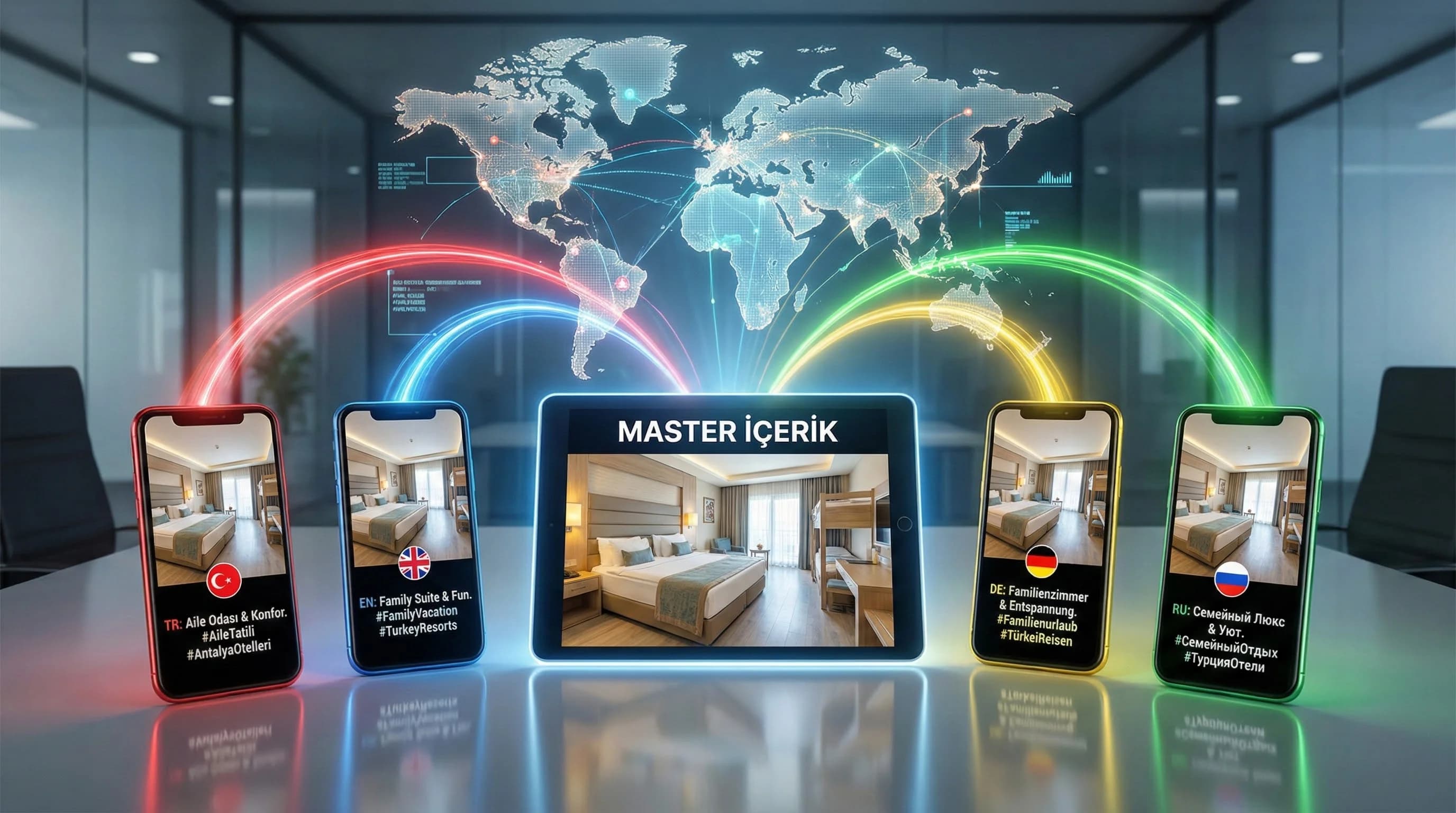
Here we show the logic of “one content → 4 languages” with an example. Aim; Placing a different caption strategy on the same image.
Master content example (Assumption)
Subject: “Family room + kids club + short FAQ” (Hotel) • Master message: “Convenience for families + practical information + clear action” • CTA target: DM / WhatsApp / link (by brand)
Caption comparison chart
The examples below are for “style demonstration”; Adapted to brand tone:
TR Caption (example)
"The most important thing on a holiday with children: comfort + speed. Your day becomes easier with our family room and kids club." Write the details in DM: 'FAMILY'."
EN Caption (example)
“Family trips should feel easy. Spacious room + kids club = more time to relax. DM ‘FAMILY’ for options & availability.”
DE Caption (example)
“Familienurlaub braucht Klarheit: Zimmergröße, Komfort und Ablauf. Schreiben Sie ‘FAMILIE’ per DM – wir senden Optionen & Verfügbarkeit.”
RU Caption (example)
“Semey отдых должен быть простым: комфортный номер + детский club. Напишите в DM «СЕМЬЯ» — отправим variants и досstuponosсstь.”
Assumption: These examples are to show “approximation”; real texts are calibrated with market data.
Version mockup of the same content in 4 languages
5. Same design or separate design? (Multilingual visual/text layout)
This decision depends on brand scale and team capacity.
Decision matrix (practical)
- •One design + different caption (minimum model): fast and sustainable
- •Single design + language tag (medium model): grid consistency + language separation
- •Language-based discrete design (advanced): high impact but high cost
What should I do?
- • Start with “one design + different caption” in the beginning.
- • Use minimal language tags on reel covers (TR/EN/DE/RU).
- • In the market that works best (e.g. DE), try the separate design only on campaign content.
6. Content Calendar and Team Organization
The real bottleneck in multilingual content is not “writing” but approval and version management.
Calendar structure (single calendar, language breakdown)
Minimum columns in monthly calendar: • Date | Channel | Format | Topic | Pillar | Language | Status | Responsible | Approved by | Asset Link
Assumption: The healthiest method for multilingualism; is to plan each language variant on a separate line and connect it with “Master Content ID”.
Approval process (language-based SLA)
- •TR: content owner + brand approval
- •EN/DE/RU: localization control + brand approval
- •Revision limit: 1–2 rounds
Hashtag and cultural usage note
- •Hashtag set should be language/market based (don't copy the same set).
- •CTA language and level of “formality” may vary by market.
- •Emoji dose should be adjusted according to premium perception.
7. Technical Note: Compatibility with multilingual web/SEO strategy
Language examples in this blog; It should be on the same table with the TR–EN–DE–RU strategy on the web side. Internal link targets: • /hotel/seo (multilingual visibility logic) • /seo/content-seo (content standard) • /hotel (tourism marketing framework)
What should I do?
- • Align your social media CTAs with relevant pages on the web.
- • Contradicting the language-based “promise” statement with the value proposition on the web.
- • Check UTM and landing page matches by language. (Hypothesis)
8. Conclusion: Content management in 4 languages is a system, not a translation
TR–EN–DE–RU social media management; It is a localization operation, not a translation operation. When you preserve the single master content and reconstruct the message, tone, CTA and hashtag according to the persona/market difference in each language; the content appears both consistent and “local.” While this approach increases interaction and return in multi-market hotel groups and B2B brands; Reduces in-team revision costs.
9. TR–EN–DE–RU Download Social Media Content & Caption Template — Multilingual SMM
TR–EN–DE–RU Download Social Media Content & Caption Template — Multilingual SMM (v1.0)
This template; It helps you rebuild hook, benefit, CTA, example and hashtag layers for TR–EN–DE–RU based on language/market, starting from a single “master content”. It reduces one-to-one translation errors, standardizes localization quality and speeds up the language-based approval process.
Kim Kullanır?
Multi-market hotel groups, tourism brands, B2B service providers; agency content and account teams.
Nasıl Kullanılır?
- Write the master content in 1 sentence (single post).
- Set persona + CTA intent for each language.
- Fill in the fields in the template and pass them through language-based approval; enter the calendar line by line.
Ölçüm & Önceliklendirme (Kısa sürüm)
- ▢ ✅ Is the master message single?
- ▢ ✅ Is there a persona definition for every language?
- ▢ ✅ Are the hooks local (not copied)?
- ▢ ✅ Is the CTA market-appropriate?
- ▢ ✅ Are the hashtag sets different?
- ▢ ✅ Are the approval flow and SLA clear?
PDF içinde: Problem→Kök Neden→Çözüm tablosu + 14 gün sprint planı + önce/sonra KPI tablosu
Bir Sonraki Adım
For teams that want to accurately calibrate the message and CTA in TR–EN–DE–RU markets.
Frequently Asked Questions
How to produce multilingual social media content?▾
Is it right to translate the same post into all languages exactly?▾
How should I adapt captions for TR–EN–DE–RU?▾
How do I manage a multilingual content calendar?▾
What is the difference between localization and translation?▾
Should I use the same design or a separate design?▾
İlgili İçerikler