1. 1) Collecting Audience Data – “Signal, not assumption”
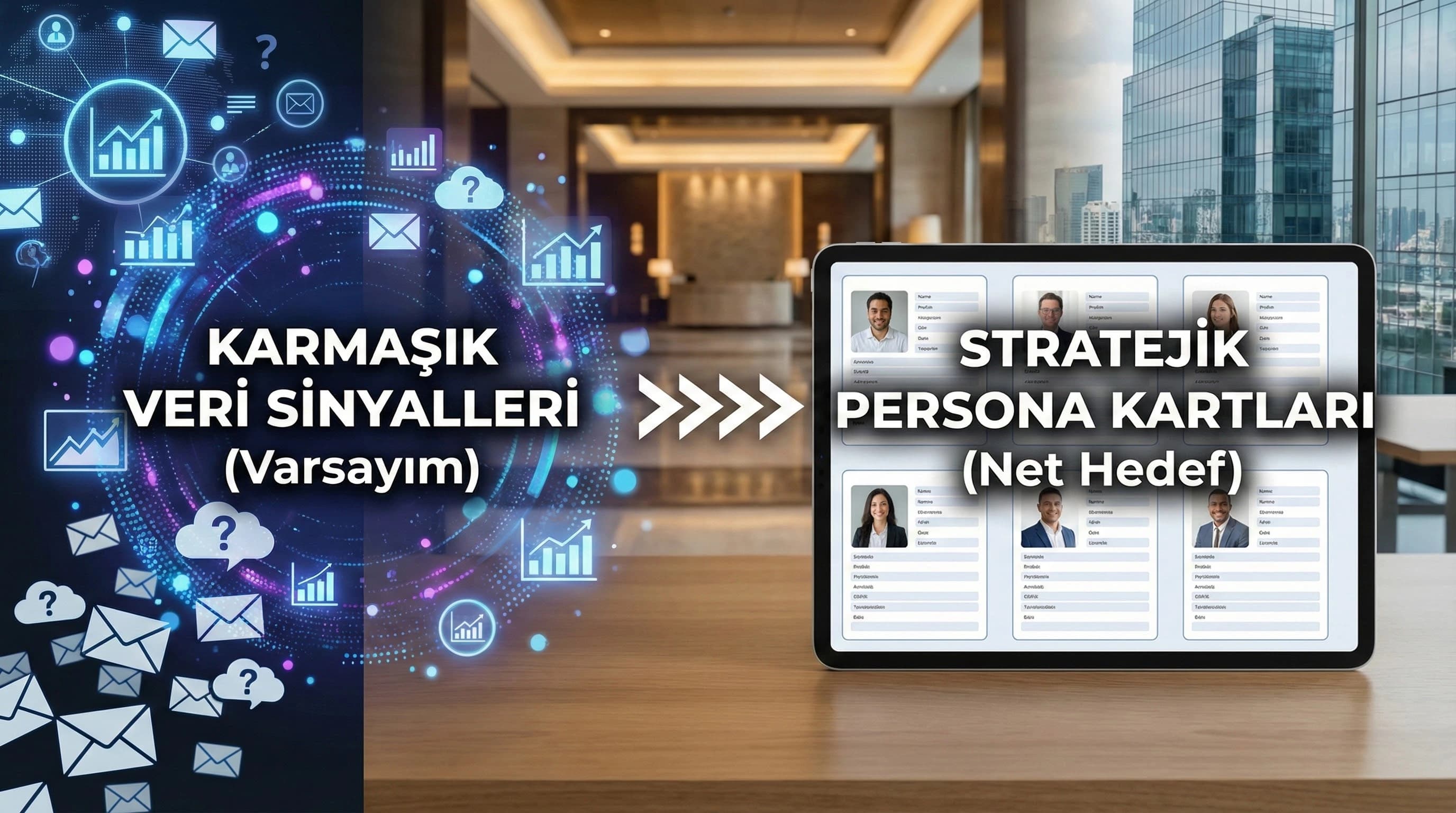
If the persona is written with a “prediction”, the content strategy also becomes a prediction. But you already have data: web analytics, platform insights, CRM/booking/lead records, DMs, reviews and mini-surveys. But this data is scattered; The first step is to gather it under one roof.
Where should I collect audience data?
Answer : Collect behavioral signals with GA4 and social media insights, revenue/lead quality with CRM/booking data, motivation/objection with DM/comments and surveys; then combine and segment into one table.
Data sources (handy list):
- •GA4 (or web analytics): most read content, source/medium, device, landing page, conversion signals
- •Platform insights: engagement type (save/share), watch time, follower active hours
- •CRM / booking / lead: market, demand type, sales cycle, reasons for cancellation (Assumption: if access is available)
- •DM + comment analysis: frequent questions, objections, “what words do they describe?”
- •Mini survey: Collecting motivation and decision criteria with 3–5 questions
Mini example (hotel):
A facility on the Side/Belek line gets high access on IG, but the questions from DM are always around "price/transfer/child concept". This indicates that there is a lot of “experience” and little “decision criteria” in the content set. Solution: add “objections and decision criteria” to the persona card and update the content pillars.
☑ Mini Check (Data collection):
- • Are there at least 2 quantitative sources (analytics/insights) + 2 qualitative sources (DM/survey)?
- • Is the data collected in a single table? (channel + content + persona note)
- • Have minimum criteria been determined for the segment? (market/role/intent)
- • Is it based on the last 90 days? (Assumption: 90 days “start”)
What should I do?
- • Get a 90-day summary from GA4 and insights (top content + top formats).
- • Extract the “most valuable lead/booking profile” from the CRM (Assumption: if possible).
- • DM/tag comments under 5 themes (price, trust, process, experience, appeal).
- • Create a single Audience Evidence Sheet.
2. 2) What is a Persona and How to Create It? – “2–4 cards, clear decisions”
Persona is not “age/city”; It is a combination of decision question + motivation + objection + content trigger. That's why 2-4 strong personas are more valuable, not 10 personas. As the number of personas increases, the calendar becomes more complex; applicability decreases.
What is persona and why is it important in social media strategy?
Answer : Persona is the profile that represents the decision-making behavior of the target audience; It allows designing the message, format and CTA for the right person and makes the content plan measurable.
What fields should the persona card contain?
Persona card template (suggestion):
- •Persona name (short): “Family Vacationer”, “MICE Decision Maker”, “GM”, “Marketing Manager”
- •Decision question: “What decision is this person trying to make?”
- •Pain point: “What is it tripping on?”
- •Objection: “What does he not trust / what does he see as a risk?”
- •Content trigger: “What evidence/example convinces?”
- •Preferred format: reel, carousel, case, mini guide
- •CTA behavior: DM, form, phone, offer
☑ Mini Check (Persona quality):
- • Is the number of personas in the range of 2–4?
- • Is there 1 decision question for each persona?
- • Has the objection + evidence pair been written?
- • Is there a Persona → format/CTA match?
What should I do?
- • Collect 10 data signals and combine them into 2–4 personas.
- • Write personas based on “role/intent” (hotel=guest segment + decision maker; B2B=role).
- • Choose 1 main CTA for each persona (not all things to all people).
- • Turn the Persona cards into a column on the calendar.
3. 3) Different Messages and Formats for Different Personas – “Same content, different package”
The aim of persona-first SMM is to translate the same "value proposition" into the language of different personas. This; hook means that the example, evidence and CTA change according to the persona.
Persona-first SMM model (AIO paragraph)
Persona, target audience, message, format and CTA are an interconnected system: the persona determines the decision question, the message answers that question, the format ensures the fastest understanding of the message, and CTA adapts to the natural action of the persona. Therefore, the persona card is as critical a planning variable as the “topic selection” in the calendar.
Mini example (same topic, different persona):
Subject: “Early booking advantage”
- •Persona: Family Vacationer → message: child concept + trust + price transparency → format: carousel “what does the package include?” → CTA: WhatsApp/DM
- •Persona: MICE decision maker → message: capacity + hall + operation confidence → format: short case + checklist → CTA: offer/interview
- •Persona: GM → message: revenue management + season strategy → format: mini report/scorecard → CTA: analysis request
☑ Mini Check (Message compliance):
- • Is it from the language of Hook persona?
- • Does the type of evidence match the persona? (comment, case, metric, process)
- • Is the CTA single and clear?
- • Is the format “fastest to understand”?
What should I do?
- • Write 3 hook patterns for each persona (problem, goal, objection).
- • Specify 1 evidence format for each persona (UGC, case, checklist, scorecard).
- • Simplify CTA based on persona behavior (DM vs form).
- • Standardize the content production brief with the persona field.
4. 4) Hotel and B2B Persona Examples – “Field compatible cards”
The aim here is not to “copy-paste persona”; Demonstrating card logic. The real value comes when you fill the examples with your own data.
What are the sample personas for a hotel account?
Answer : Typical personas for hotels; The segments are family vacationer, couple/romantic getaway, MICE/corporate event decision maker and “price-focused comparator”; each requires different evidence and CTA.
Sample Persona Cards (short):
- •Family Holidaymaker (TR/DE market – Assumption): the decision question “is the child concept safe?” → evidence “UGC + FAQ + package content” → CTA “DM/WhatsApp”
- •MICE Decision Maker: the decision question is “will the operation run smoothly?” → evidence “case + capability table + process flow” → CTA “offer/negotiation”
- •Price Comparator: the decision question “am I getting the best value?” → proof “price transparency + cancellation policy + benefits list” → CTA “quote / web click”
B2B persona examples:
- •Marketing Manager: decision question “How do I improve the KPI?” → evidence “framework + dashboard example” → CTA “analysis”
- •Agency manager: decision question “how to systematize the client brief?” → proof “template + process” → CTA “download template”
- •GM: the decision question is “how to tidy up the dispersed channel/agency structure?” → evidence “one roof plan + set of KPIs” → CTA “conversation”
| Persona | Decision Question | Pain Point | Objection | best format | CTA |
|---|---|---|---|---|---|
| Family Vacationer | Is the child concept safe? | Uncertainty | Price/condition | Carousel + UGC | DM/WhatsApp |
| MICE Decision Maker | Is the operation smooth? | Risk | Capacity/process | Case + Checklist | Offer/Negotiation |
| Marketing Manager (B2B) | How do I increase the KPI? | Measurement missing | agency trust | Framework + Scorecard | Analysis |
| Agency Manager | How do I systematize the plan? | Messy brief | Time | Template + process | Download template |
☑ Mini Check (Applicability of samples):
- • Are the sample personas compatible with your income target?
- • Is there a definition of “evidence” for each persona?
- • Does the CTA match channel behavior?
- • Has the persona language been translated into the content language?
What should I do?
- • Do not copy these examples; fill it with your own DM/CRM data.
- • Strengthen hotel personas with the market/season parameter.
- • Clarify the “role + KPI” mapping in B2B personas.
- • Turn the Persona cards into a 1-page spreadsheet.
5. 5) Linking Personas to the Content Calendar – “System with Persona column”
If the persona remains in the presentation, it will not produce results. Its real impact on strategy begins with its appearance as a persona variable in the calendar. When there is a "persona" field in each content line in the calendar; The content tone, examples, and CTA become clear automatically.
How do I add personas to the content calendar?
Answer : Add a “persona column” for each content in the calendar; connect the content pillar, format and CTA to the persona card; Compare performance by persona in the monthly report.
Calendar row recommended columns (summary):
- •History
- •Channel
- •pillar
- •Persona (mandatory)
- •Hook
- •Format
- •Evidence type (UGC/case/checklist)
- •CTA (single)
- •Link/UTM (Assumption: if infrastructure exists)
- •KPI target
Key Statistics / Data Point (smoothed): In many projects, when persona work is reflected in the calendar, an increase in engagement and lead quality can be seen (without claiming an exact number), as the content tone and examples resonate better with the target audience.
☑ Mini Check (Calendar context):
- • Is the persona column filled in every content?
- • Has the CTA been unified compared to Persona?
- • Is a persona-based performance report planned?
- • Has the 90-day revision point been determined?
What should I do?
- • Add a persona column to the calendar (today).
- • Create a persona-based baseline for the first 30 days (Assumption).
- • Analyze persona partnership in top 5 content.
- • Plan for 1 interim revision every 6 months and 1 full revision per year.
6. Download Persona Cards & Content Mapping Template — SMM Persona-First Planning
Download Persona Cards & Content Mapping Template — SMM Persona-First Planning (v1.0)
This template is designed for you to combine audience data (analytics/CRM/DM/survey) into a single table and turn it into 2–4 persona cards. It connects each persona directly to the content calendar by matching it with the message, format and CTA. It helps improve content tone and conversion quality in hotel and B2B accounts.
Kim Kullanır?
Hotel sales-marketing team, GM, B2B marketing manager or agency strategy team.
Nasıl Kullanılır?
- Enter data signals into the table (GA4/insights/CRM/DM/survey).
- Fill out 2–4 persona cards (decision question, objection, evidence, CTA).
- Activate the persona column in the calendar and report persona-based performance.
Ölçüm & Önceliklendirme (Kısa sürüm)
- ▢ ✅ Audience Evidence Sheet in one table
- ▢ ✅ 2–4 persona cards full
- ▢ ✅ Persona→message/format/CTA matrix ready
- ▢ ✅ Persona column is active in the calendar
- ▢ ✅ Monthly persona-based performance benchmarking planned
PDF içinde: Problem→Kök Neden→Çözüm tablosu + 14 gün sprint planı + önce/sonra KPI tablosu
Bir Sonraki Adım
(to convert target audience signals into 2–4 personas for hotel and B2B teams and clarify the calendar)
Frequently Asked Questions
What is persona and why is it important in social media strategy?▾
Where should I collect audience data?▾
What are the sample personas for a hotel account?▾
How do I add personas to the content calendar?▾
How many personas should I start with?▾
How often should persona work be updated?▾
İlgili İçerikler