1. What is hotel SEO and why is it different from classic SEO?
Hotel SEO knows the rules of “general SEO” but establishes a structure adapted to the realities of tourism: seasonal demand, multiple markets, multiple languages, room/concept diversity, Google Hotel Pack and metasearch layer… Classic SEO often proceeds with the logic of “product page + blog”; In the hotel, “room page + offer page + experience/destination content + multilingual architecture” must work together.
How hotel SEO works despite OTA and metasearch
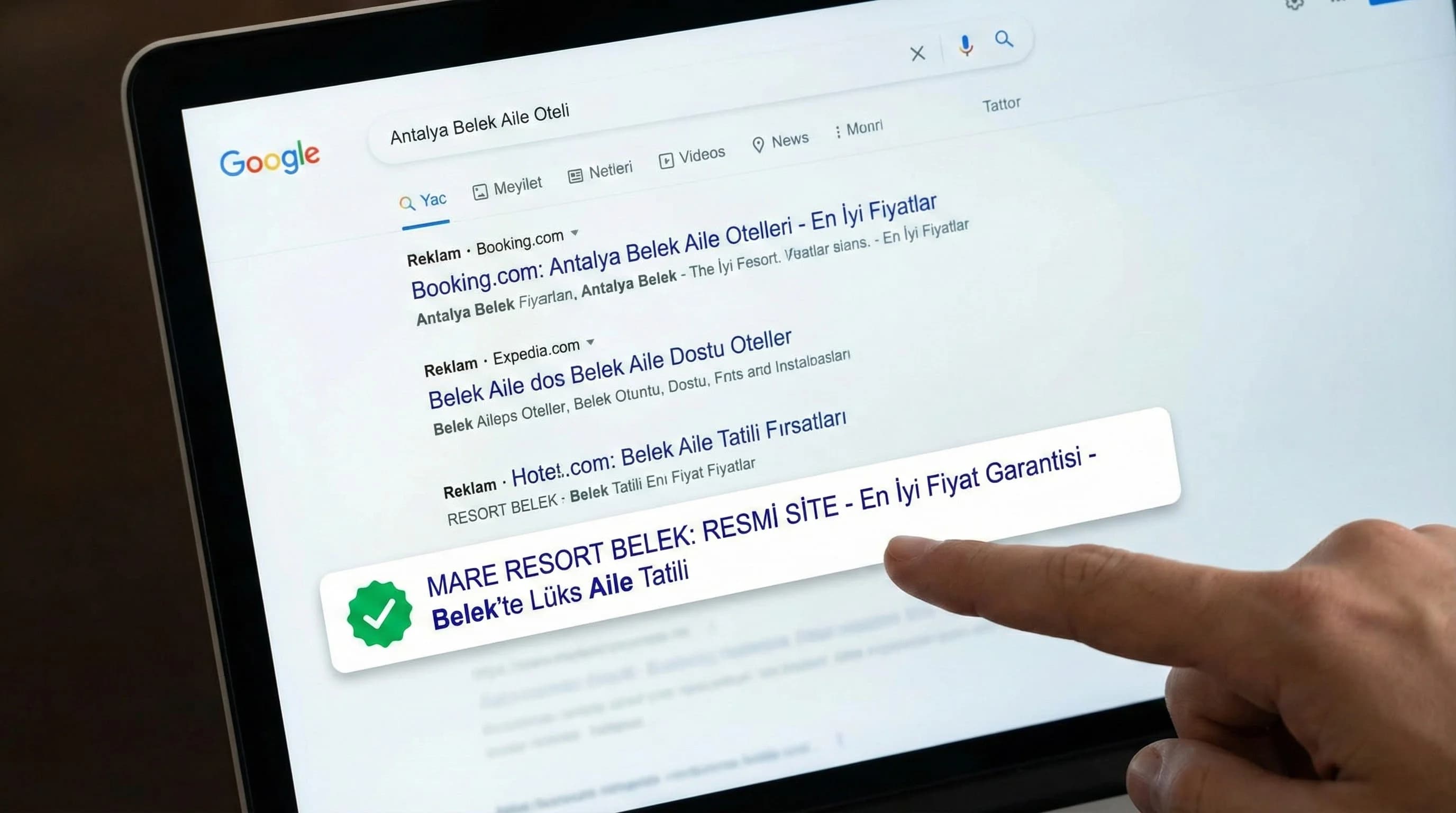
OTAs are generally strong on “brand search” (your hotel name) and “destination + hotel” queries. Hotel SEO aims for two things: (1) Protecting brand demand (official site trust), (2) Growing non-brand demand (visibility in destination/concept/experience searches).
Distinction between brand searches vs destination searches (the most critical distinction)
- •Brand searches: “X Hotel”, “X Hotel price”, “X Hotel contact”
- •Destination searches: “Belek family hotel”, “Side all-inclusive resort”, “Bodrum honeymoon hotel”, “Antalya beachfront hotel”
The target of the brand; It gives the user confidence in the "official site" and facilitates direct streaming. Target in the destination; is to capture the demand for the first time and position the hotel with the right concept promise.
2. How to position yourself on Google despite OTA competition?
OTA competition appears to be a “ranking” problem; But in most hotels, it is actually a positioning and page type problem. Google shows different SERP components for different query types: organic results, Hotel Pack, map, PAA, snippet… Hotel SEO combines two goals here: 1. Visibility in Hotel Pack and local signals, 2. Response with the “right page types” in line with the intent in organic.
Reading Google Hotel Pack/Travel layer correctly
Google Hotel Pack generally works with the following signals: consistency of business information (address/phone/location), user experience and trust (site speed, mobile, content integrity), review and authority signals (reviews, brand searches, testimonials). Critical point: Hotel Pack is not a “separate universe from SEO”; With the right setup, organic + local + brand signals work together.
SEO role of room/property pages (why do most hotels lose out here?)
Room pages are usually left as "3 photos + 5 features + price". However, what makes direct booking grow is the content that facilitates the user's decision: who is it suitable for, features that make a difference, FAQ and cancellation/flexibility clarity, immediate surroundings/destination context (e.g. golf in Belek, access to the ancient city in Side).
The framework that makes the difference (closing the Competitor Gap)
- •OTA competition (SERP reality)
- •Hotel Pack / Travel tier
- •Multilingual structure (hreflang) and market logic (DE/RU/UK)
- •Direct booking KPI set (revenue, not just traffic)
What should I do?
- • Divide the SERP into query clusters: brand / destination / concept / room / offer.
- • Determine the correct page type for each query set (room–property–destination–blog).
- • Strengthen NAP consistency + speed + trust signals for Hotel Pack.
- • Target the PAA area by adding short FAQ blocks to room pages.
3. Basic steps of direct booking focused hotel SEO strategy
“Success” in hotel SEO is not just more traffic; is to generate direct reservations from the right traffic. This requires clarifying the funnel logic: the user first discovers you in the destination/concept, then goes down to the room/offer page, then moves on to the booking flow.
1) Query sets → page types mapping (fastest win)
- •Destination / experience queries → Destination / experience landing + related blog content
- •Room/accommodation inquiries → Room pages (rich content + FAQ)
- •Offer / campaign inquiries → Offer pages (clear conditions + trust)
- •Brand queries → Home/brand page (official site signal)
2) Internal link architecture: decentralizing silo authority
Since this is content “101,” internal linking goals are critical: it is necessary to move authority to the service page and subdirectories. When the flow is established with the logic of hub → service → blog → room/offer, both Google and the user "understand" the site better.
3) Content set plan (TR + European markets)
Target in multilingual markets; It is to adapt each language according to intention and market expectation, not by "copy translation". Example: TR (Belek family hotel), DE (Belek Familienhotel), RU (Antalya family hotel), EN/UK (Antalya family resort).
What should I do? (90 days plan)
- • Extract your query set → page type table and mark the missing ones.
- • Complete the destination/concept pages first; Link blogs internally to room/offer pages.
- • Technically verify the multilingual structure (hreflang); Then create content.
- • Start with at least 1–2 “winning” destination pages for each language.
4. Technical SEO + content + local SEO triangle
For hotel SEO to be sustainable, the three corners of the triangle must work together. If the technical foundation is weak, the content will be wasted; If there is no content, technique alone will not bring direct booking; If local signals are weak, the Hotel Pack side will be incomplete.
Canonical, index control and page consistency
- •Reduce the risk of duplicate URLs with fixed canonical (especially parameter/UTM).
- •Clarify indexability controls (robots, sitemap, noindex).
- •Refresh "aging" pages with a 365-day refresh cycle.
Multilingual structure and hreflang (TR/EN/DE/RU)
The most common mistake on multilingual hotel sites: languages exist but Google does not say "these are equivalent". When hreflang is not set up correctly; The TR page can be shown to the DE user, and the EN page can be shown to the RU user. Rule of thumb: Every language page carries a reciprocal hreflang reference; language + country targeting is done according to the strategy; Language pages should be adapted to market expectations, not copies of each other.
Where content + local signals meet
Local SEO is not just Google Business Profile; The local context should also be reinforced on the hotel site: transportation, environmental experiences, season insights, map/location widgets, consistent contact information.
What should I do? (technical priorities)
- • First clear index & canonical issues; then accelerate content production.
- • Verify hreflang (inter-language page reciprocity).
- • Connect local signals to content strategy: destination pages + blog + room pages.
- • Plan schemas with monolithic @graph logic; Feed the FAQPage with real questions.
5. KPIs that measure hotel SEO success (occupancy, RevPAR and organic bookings together)
Most hotel SEO reporting errors come from: looking only at “traffic growth.” However, what is critical in the hotel is the effect of SEO on revenue and booking behavior. KPI set; brand demand, Hotel Pack visibility, direct funnel and revenue metrics should be read together.
Hotel SEO KPI set (practical and manageable)
| KPI | What does it measure? | Source | Note/usage |
|---|---|---|---|
| Organic session (brand / non-brand) | Demand change | GA4 | Brand & destination distinction is a must |
| Organic direct booking conversion rate | Quality + funnel | GA4 + booking engine | Micro steps should be tracked separately |
| Organic booking share | channel balance | PMS/CRS + GA4 | Assumption band: 10–25% may occur in some hotels |
| Hotel Pack visibility/clicks | Local + SERP share | GBP/Looker/3rd party | Critical for destination queries |
| Average room revenue / RevPAR relationship | Income impact | PMS/BI | SEO is not alone; but trend correlation is read |
| Brand search volume trend | Brand demand | Search Console / Trends | Also captures campaign + PR impact |
Key data point (softened usage): In a well-designed hotel SEO structure, it can be seen that in some facilities the share of the organic channel in the total online reservations on the direct booking side can reach 10-25% (depending on the facility, market, season and product-price strategy).
KPI reading errors (3 most common errors)
- •Not distinguishing between brand / non-brand (you cannot see real growth)
- •Saying “Traffic increased” but not measuring conversion steps
- •Not reading the SEO report on the same dashboard as RevPAR/occupancy
What should I do? (reporting rhythm)
- • Fix your KPI set at 10–12 metrics; Set a weekly/monthly rhythm.
- • Add brand/non-brand and market (DE/RU/UK/TR) breakdowns to the report.
- • Combine Hotel Pack + organic + direct funnel metrics in a single dashboard.
- • Refresh content regularly with a 365-day refresh cycle.
6. Download Hotel SEO Checklist (PDF) — Hotel SEO
Download Hotel SEO Checklist (PDF) — Hotel SEO (v1.0)
This asset is designed for hotels facing OTA competition to quickly scan their current SEO status, flag the most critical bottlenecks (technical, content, local, multilingual) and come up with an actionable priority plan within 14 days. The result gets you to the point of “we know what to do.”
Kim Kullanır?
GM/hotel owner, sales-marketing manager and agency/SEO officer.
Nasıl Kullanılır?
- Complete the checklist in 30–45 minutes (mark red/yellow/green).
- Select the top 10 actions in the “Problem → Root Cause → Solution” table.
- Implement the 14-day sprint plan and measure the before/after difference with the KPI card.
Ölçüm & Önceliklendirme (Kısa sürüm)
- ▢ ✅ Brand vs non-brand organic traffic distinction is included in the report
- ▢ ✅ Hotel Pack metrics are measured
- ▢ ✅ Room pages contain FAQ + decision-making content
- ▢ ✅ Destination content set (Antalya/Belek/Side/Kemer/Bodrum) planned
- ▢ ✅ TR/EN/DE/RU hreflang mutual and error-free
- ▢ ✅ Canonical/index issues are clear
- ▢ ✅ Internal link targets (hub → service → blog) are working
- ▢ ✅ Direct booking funnel microtransactions are tracked
PDF içinde: Problem→Kök Neden→Çözüm tablosu + 14 gün sprint planı + önce/sonra KPI tablosu
7. Conclusion: The way to win despite OTA is not "one move", but the system
Hotel SEO is not a single “SEO effort”; It is technical basis + content set + local signal + KPI reading system. OTAs may remain strong; But you can be visible with the right page types in the right query sets and speed up the direct booking flow.
This article is the cornerstone of the silo; In the follow-up content, room page optimization, destination pages, hreflang, Hotel Pack strategy and measurement panels will be deepened.
Bir Sonraki Adım
Let's make a priority list to balance your OTA share and grow organic to direct bookings.
Frequently Asked Questions
What is hotel SEO, how is it different from classical SEO?▾
How can my hotel rank higher on Google despite OTAs?▾
Where should I start with SEO for direct booking?▾
What KPIs should I look at in hotel SEO?▾
Is SEO related to Google Hotel Pack?▾
Why is hreflang so important on multilingual hotel sites?▾
Does destination content really bring bookings?▾
How long does it take for hotel SEO to yield results?▾
İlgili İçerikler