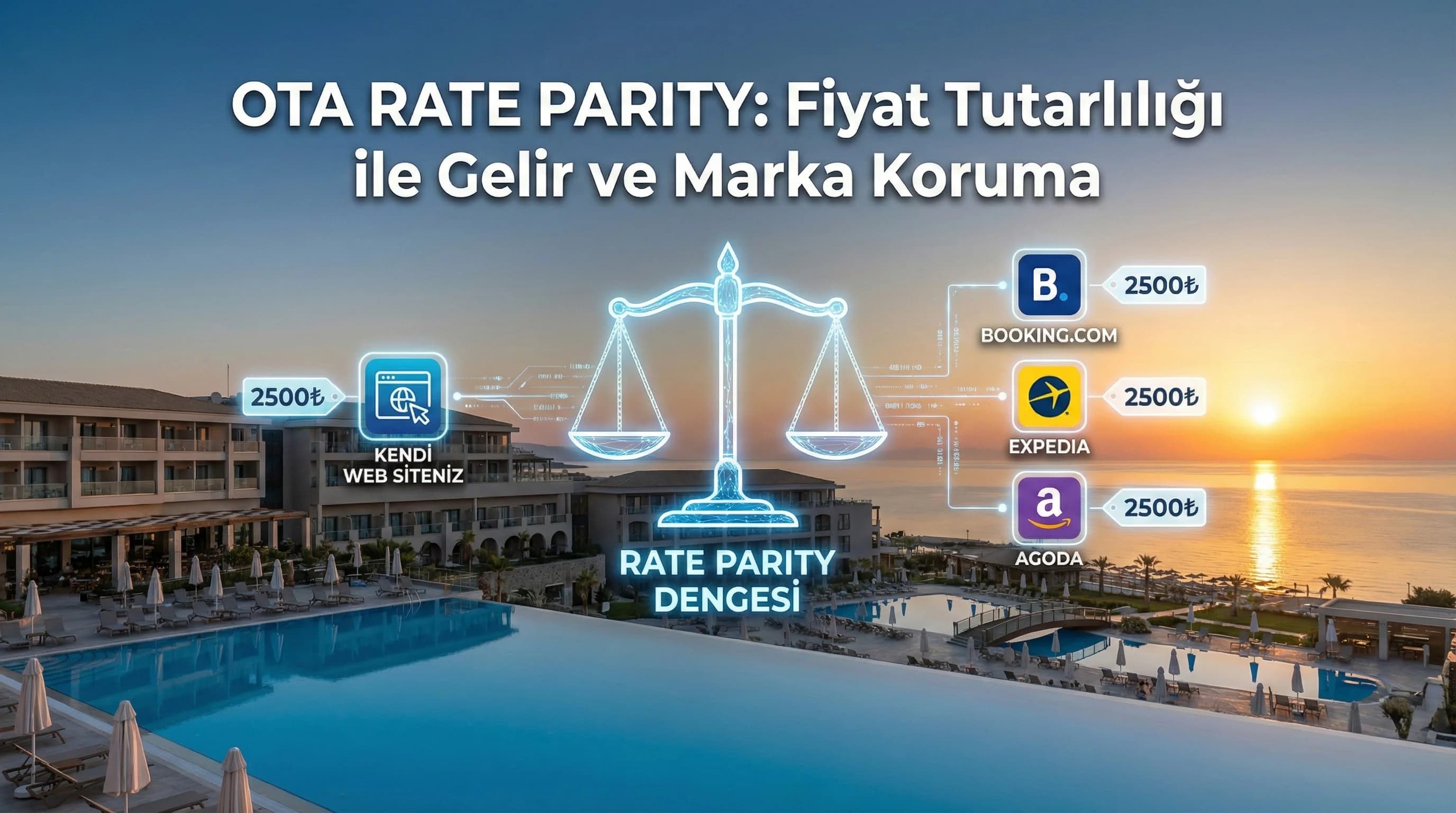
1. What is rate parity and why is it important?
Rate parity, in its simplest form, is “prices remaining at a manageable consistency across channels for the same room and date.” The goal here is not to see exactly the same number in every channel; It is to prevent uncontrolled differences in the rules determined according to the hotel's strategy. When parity breaks, the guest moves to the cheaper channel; The team asks internally: "Why are our prices so messed up?" struggles with the question.
Short answer block (2–3 sentences): Parity is maintained by properly spreading the base rate to derivative rates and controlling campaign/mobile/geo prices. If left unnoticed for a long time, commercial frictions such as loss of visibility or commission pressure may be triggered in some OTAs. Proper parity management protects both revenue and channel relationships.
☑ Mini Check (H2-1): Is there a parity risk signal?
- • I see "unexplainable" differences between channels for the same date/room
- • Prices get out of control when mobile/country prices come into play
- • When you open a campaign, parity "breaks" and it takes days to fix it
What should I do?
- • Put the “Base rate + derived rate” fiction in writing.
- • Limit mobile/geo and campaign prices with parity rules.
- • Establish a weekly parity check routine (box below).
2. How does price flow work in the PMS–Channel–OTA chain?
The heart of rate parity is the question of where price is generated and how it is distributed. “BaseRate” should come from a single place and derivative rates (DerivedRate) should be produced with a controlled logic. Writing rules to the same rate plan in two different panels (PMS + channel manager) is the anti-pattern that most frequently breaks parity.
AIO relational expression (natural): BaseRate → propagatedTo → OTA Channels. DerivedRate (mobile/geo/campaign) → constrainedBy → Parity Rules.
Practical flow: • PMS or RMS: base rate • Channel manager: distribution, channel-based restrictions, controlled derivative prices • OTA: showcase; Can “show” price with layers like device/country/loyalty
☑ Mini Check (H2-2): Single source truth
- • I manage base rate from a single panel
- • In what situations do derivative rates come into play?
- • Channel-based constraints (stop-sell/min stay) are set so as not to violate parity.
What should I do?
- • Lock the base rate to a single “authority panel”.
- • Keep derivative rates (mobile/geo/loyalty) limited and trackable.
- • Verify the “actual price” with post-distribution spot-check.
3. Common price mistakes and their consequences
Most competing content passes parity in a single paragraph; The most painful part in practice is the "error types". The following 5 mistakes are the most common reasons why hotels lose parity.
The 5 most common parity errors
- •Double panel rule writing: discount in PMS + discount in CM → conflict and inconsistent price
- •Rate plan bloat: unnecessary many plans → control becomes difficult, the possibility of error increases
- •Mobile/geo price uncontrolled: aggressive price drop in some markets
- •Campaign stacking: OTA campaign + your own promotion stacked on top of each other
- •Tax/fee included-excluded confusion: the same price “seemingly” differs
Results (no exaggeration): • Guest shifts to cheaper channel → channel balance is disrupted • Team's correction burden increases → loss of time and stress • Risks of fluctuation in visibility trends and commercial friction if left undetected for long periods of time
| Parity Error | Conclusion | Correction |
|---|---|---|
| Double panel rule writing | Inconsistent price/conflict | Move rule to single authority panel |
| Rate plan inflation | Control becomes difficult | Simplify plans, establish clear logic |
| Mobile/geo uncontrolled | Aggressive decline in some markets | Limit with lower limit + ceiling |
| campaign stacking | Discount overlaps | Write stacking rule, prevent conflict |
| Tax/fee included-excluded confusion | Seemingly different price | Fix display standard |
☑ Mini Check (H2-3): Which error do you have?
- • I give the same discount in both places (PMS + CM)
- • I don't know "by how much" mobile prices have fallen.
- • When a campaign is opened, prices go out of control
What should I do?
- • Reduce the number of rate plans (fewer plans + clear logic).
- • Limit campaign conflicts with the “stacking rule”.
- • Standardize tax/fee representation.
4. How to manage parity when there are OTA campaigns?
OTA campaigns (mobile, country-based, member/loyalty, last minute, etc.) are the “secret busters” of parity. Because it affects the "visible" layer of the price and often the hotel team may not notice the effect of the campaign in real time.
- •Lock base rate: let the campaign affect the derivative rate, not the base rate
- •Set campaign limits: define maximum discount/lower limit
- •Prevent stacking: do not overlap two campaigns (or overlap them in a controlled manner)
- •Monitor mobile/geo prices: Increase spot control in competitive destinations such as Antalya/Bodrum
- •Set a channel-based target: Which price role plays which channel? (acquisition vs repeat)
- •Write a correction procedure: when a violation is detected, "who, from where, and in how many minutes" will correct it?
Mini example (GEO): When the OTA mobile campaign comes into play during peak weekend demand in Antalya, your web price may appear lower on OTA mobile, even if it remains "normal". The solution here is not to drop the web; It is to manage the base rate and campaign limits with parity rules.
☑ Mini Check (H2-4): Campaign check
- • I have a list of campaign types (mobile/geo/loyalty)
- • I set a campaign discount ceiling
- • When the campaign is opened, I enter the automatic parity check.
What should I do?
- • Connect the campaign opening/closing process to an “approval flow”.
- • Check mobile/geo prices more frequently during demand periods, rather than weekly.
- • Make a spot-check of the "display price" within 24 hours after the campaign.
5. Rate parity monitoring and correction processes
Parity management is not “one and done”; It is the watch-catch-correct cycle. The aim here is to catch the violation before it escalates and standardize the correction.
Weekly Rate Parity Checklist ☑ Mini Check (Weekly):
- • Select 5 critical date ranges (this weekend, next 2 weeks, 30 days ahead, high demand days)
- • Choose 3 critical room types (best selling, most expensive, entry level)
- • Check 3 channels (Booking, Expedia, web) + mobile view
- • Where is the lowest price? Can the reason for the difference be explained?
- • Is there any campaign/geo/mobile impact?
- • If correction is required: panel + responsible + SLA (e.g. 30–60 min)
- • Keep a log of results (what improved, what repeats?)
Industry observation (softened): It is observed that when parity problems are not noticed for a long time, commercial frictions such as fluctuation in visibility trends and commission/condition pressure may occur in some OTAs. In the opposite case, regular parity management helps you establish the web-OTA balance in a more controlled manner.
6. CTA
7. Rate Parity Weekly Control Checklist - PMS & OTA Management
Rate Parity Weekly Control Checklist - PMS & OTA Management (v1.0)
This checklist establishes a weekly spot-check rhythm to catch parity violations “before a complaint is made”. It aims to quickly detect invisible risks such as mobile/geo campaigns, derivative rates and campaign stacking. Result: less revenue leakage, more controlled web–OTA balance.
Kim Kullanır?
Hotel owner, RM, reservations manager and channel manager/agency team.
Nasıl Kullanılır?
- Choose from 5 critical dates and 3 critical room types per week.
- Spot-check via Booking + Expedia + web (and mobile view).
- If there is a breach, close the root cause with a 14-day remediation plan.
Ölçüm & Önceliklendirme (Kısa sürüm)
- ▢ ✅ Base rate is managed from a single source (PMS/RMS or CM)
- ▢ ✅ Derived rate types listed (mobile/geo/loyalty/campaign)
- ▢ ✅ Campaign stacking rule written
- ▢ ✅ Tax/fee included-excluding standard net
- ▢ ✅ 5 dates × 3 rooms × 3 channels spot-check plan available
- ▢ ✅ The “why” of the lowest price can be explained
- ▢ ✅ Has remediation SLA (e.g. 30–60 min)
- ▢ ✅ Weekly parity log is kept
PDF içinde: Problem→Kök Neden→Çözüm tablosu + 14 gün sprint planı + önce/sonra KPI tablosu
Bir Sonraki Adım
For hotels that want to reduce parity violations and control their web-OTA balance.
Frequently Asked Questions
What is rate parity and why is it important for hotels?▾
How is price equalization achieved in OTAs?▾
How do rate parity violations affect the hotel?▾
How to manage parity when there are OTA campaigns?▾
What should be checked weekly to maintain parity?▾
What is the most common parity error?▾
İlgili İçerikler
İlgili Yazılar