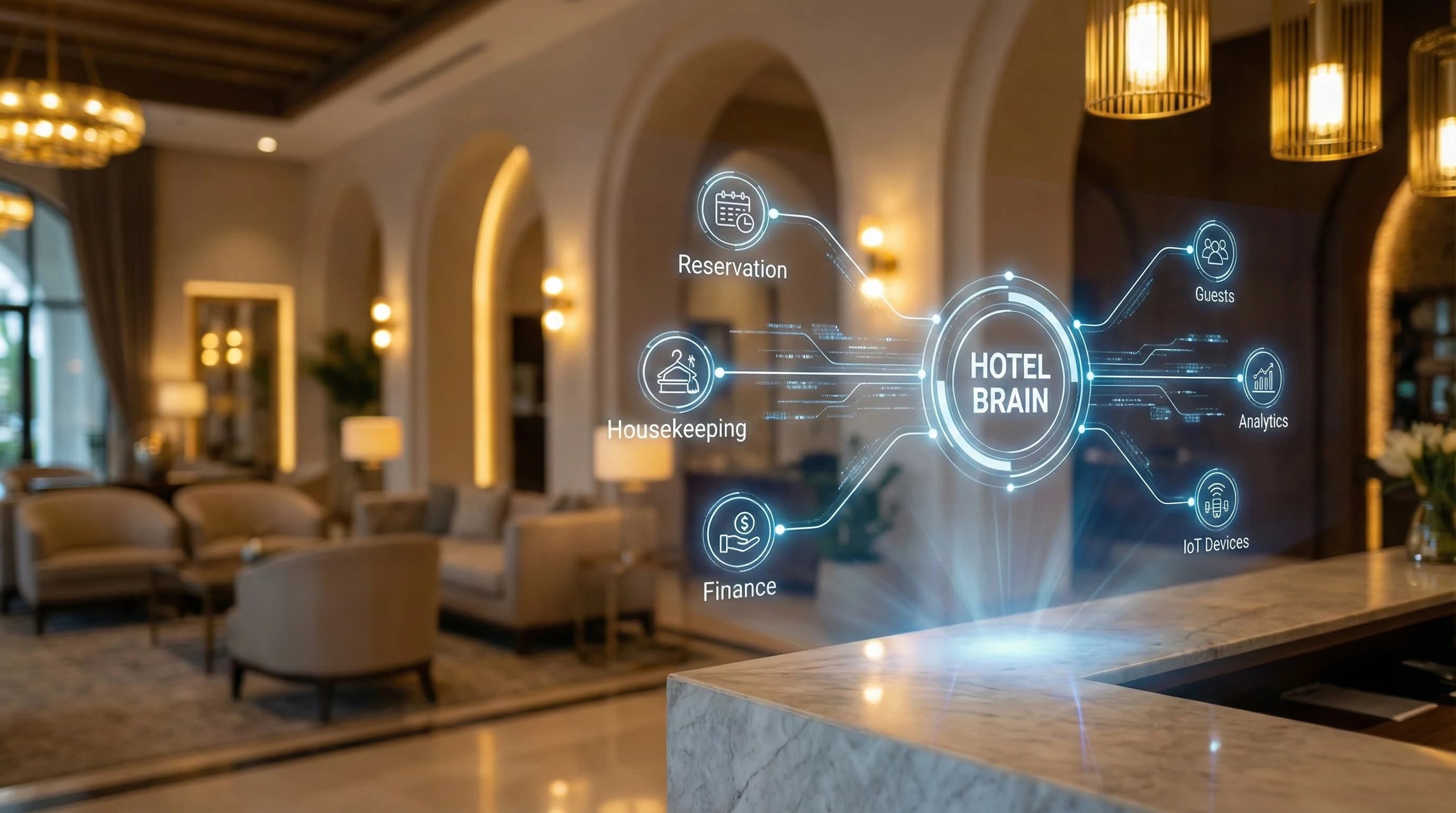
1. What is PMS and What Problem Does It Solve?
PMS basically enables the management of reservation-accommodation-invoicing-housekeeping-front office processes from a single center. However, the real gain in hotels is that the data becomes a single source of truth rather than a "single screen transaction": the right room stock, the right price/contract, the right guest profile and the right report output.
Consider the problems PMS solves under 4 headings:
☑ Mini Check
“Do I expect PMS to be software or a backbone that standardizes business flow?”
What should I do?
- •Define PMS as a “data + integration backbone”, not a “front office screen”
- •Write down the 3 most critical flows: reservation → check-in → invoice; OTA → stock/price; report → decision
- •Who takes part in these 3 streams? (reception, revenue, sales, accounting, call center)
2. PMS Needs Analysis by Hotel Type
The same PMS gives completely different results in different hotel types. Resort hotels on the Antalya–Belek–Side line; It stands out with its high volume, multiple outlets, peak season fluctuation and group/contract management. In the boutique/villa segment in Bodrum, fast sales, flexible price packages, different channel mix and "more work with fewer people" may be critical.
Perform needs analysis with the following 3 layers:
- •Must-have: room/inventory, check-in/out, invoice/folio, housekeeping, reports
- •Scale: multi-property/multi-outlet, group/contract, CRM basic integrations
- •Competition (Moat): Revenue Management compliance, call center flow, advanced reporting, automation
Decision Matrix (Hotel Type × Needs)
| Need / Hotel Type | Resort (Antalya/Belek/Side) | City Hotel | Boutique | Villa |
|---|---|---|---|---|
| Fast check-in/out at high volume | very critical | Critical | Middle | Middle |
| Group / contract / allotment | very critical | Middle | Low | Low |
| OTA + Channel Manager sync | very critical | Critical | Critical | Critical |
| Multiple outlet / POS / invoice flow | Critical | Middle | Low-Medium | Low |
| Housekeeping intensity | very critical | Critical | Middle | Low-Medium |
| Revenue management (RMS) compliance | very critical | Critical | Middle | Middle |
| Call center integration | Critical | Middle | Middle | Middle |
| Flexible package/long stay | Middle | Low | Middle | Critical |
☑ Mini Check
“What is the most expensive mistake in my hotel type: overbooking, report blindness, or team time?”
When evaluating your PMS choice, consider the PMS + Channel Manager + OTA + Call Center + Revenue Management chain simultaneously; Because if these five are optimized separately, the total will be a disjointed system. For a framework approach on how to manage this chain: /pms-ota and for integration details: /pms-ota/ota-contract.
What should I do?
- •Clarify the hotel type (resort/city/boutique/villa) and create a 10-item “must-have” list
- •Write seasonality and channel mix (OTA share, direct share, call center share)
- •Identify 5 systems where “integration is a must” (OTA/CM, accounting, POS, RMS, call center)
3. What should I pay attention to when choosing PMS?
When choosing a PMS, first determine the needs according to your hotel type, then verify the modules and integrations (OTA/Channel Manager, accounting, call center, API). Measure the demo/pilot process with KPIs (speed, accuracy, report) and move on to the deployment project with a plan, clarifying the scope of data migration, support/SLA and integration in the contract.
Questions to Ask When Choosing a PMS (Question set)
The following set of questions breaks the “product demo” trap and leads to the actual purchase decision:
1) Operation questions
- •How many steps is the reception and housekeeping flow? Are there any unnecessary clicks?
- •Is the process blocked on a busy check-in day? (performance test)
- •Can user permissions be managed on a department basis?
2) Distribution & channel questions (OTA/CM)
- •Is Channel Manager/OTA sync “instantaneous” or “periodic”? How is overbooking risk managed?
- •Is the cancel/no-show flow automatic or manual?
3) Integration questions (critical part)
- •Which data flows in which direction between PMS–OTA–Call Center–Accounting–RMS?
- •Is there API integration or “off-the-shelf connector”? (technical note below)
- •How are integration errors reported, who intervenes?
4) Report & decision questions
- •Are standard reports sufficient? How to make a special report if necessary?
- •Can channel cost and revenue analysis be made?
5) Contract & risk questions
- •Scope of data migration and who is responsible?
- •What is the support model/SLA? How does emergency support work in season?
- •Is the exit plan (data export, end of contract) clear?
☑ Mini Check
“Is what I'm buying software or a process + integration + support package?”
Cloud vs On-Premise (Classic) PMS: When is which?
- •Cloud PMS: Works over the Internet; Updates can be faster, access in multiple locations is easy.
- •Classic/On-premise PMS: Runs on the hotel's own server; There may be a control/habituation advantage in some facilities, but the maintenance and update burden may increase.
What should I do?
- •Reduce pre-demo question set to one page (use in purchasing meeting)
- •Talking about price without creating the integration map
- •Clarify the “data migration + support + integration scope” clauses in writing in the contract.
4. Demo, Pilot and Reference Check
A demo is generally a “best case” presentation; The pilot is the test of the system in real life. So make the demo/pilot plan measurable.
Demo Plan (1–2 weeks): What should I measure?
- •Check-in/out scenario (busy day simulation)
- •OTA/Channel Manager synchronous test (stock/price update + cancellation flow)
- •Report accuracy (same day, consistency across different reports)
- •Authorization (department-based access, log records)
Pilot Plan (2–4 weeks): Rehearsal with “real data”
In Pilot, the goal is not only for the team to do the job “faster” but also to see how the system behaves in case of failure: what happens when the integration is interrupted, how are the reports affected, is there a manual fallback?
Reference Check: 7 clear questions to ask
- •How many months has it been used in a facility similar to our hotel type?
- •How is the support rate during the season?
- •What was the biggest surprise? (cost/integration/team adaptation)
- •How long did the data migration take?
- •Were there any problems with OTA/Channel Manager synchronization?
- •Are the reports sufficient to make decisions?
- •What would they do differently if they were re-elected?
☑ Mini Check
“In the reference call, the question is not 'Are you satisfied?', but 'What was the biggest surprise?'"
What should I do?
- •Convert demo to “test” format rather than “presentation”
- •Set start-end criteria for the pilot (conditions for being considered successful)
- •Get reference questions in writing (later they become part of the contract)
5. Transition from PMS Selection to Installation Project
Once the selection is complete, the real risk begins: the installation is seen as an “IT job” and if the operation does not take ownership, the project will drag on. The right approach: to manage the installation project as a business transformation.
Deployment Project Roadmap (example)
“PMS Election File” Skeleton
A practical framework that can be given to your team with this article:
- •/01_Needs-Analysis/ (hotel type, must-have list, process flows)
- •/02_Integration-Map/ (PMS–OTA–Call Center–Accounting–RMS data flow chart)
- •/03_Demo-Pilot/ (KPI card, scenario list, test results)
- •/04_Agreement-SLA/ (scope, data migration, support, exit plan)
- •/05_Setup-Project/ (calendar, responsibility matrix, training plan)
- •/06_Reporting/ (standard reports, decision dashboard needs)
☑ Mini Check
“If I don't have a selection file, my installation project grows uncontrolled.”
Technical Note:
- •Cloud-based PMS: You access the software over the internet; Updates are managed by the provider.
- •API integration: Two systems (e.g. PMS and call center) transfer certain data to each other “in a regular way”; This reduces manual copy-paste and reduces the risk of errors.
Related internal links
- •PMS & OTA framework: /pms-ota
- •Installation & support: /pms-ota/pms-integration
- •OTA integration: /pms-ota/ota-contract
- •Channel management: /pms-ota/channel-management
What should I do?
- •Assign “job owner” to the installation project (ops + IT together)
- •Clarify data migration and integration scope before go-live
- •Prepare a “stabilization” checklist for the first 30 days
6. Download PMS Selection Checklist — PMS & OTA (v1.0)
Download PMS Selection Checklist — PMS & OTA (v1.0)
This document has been prepared for you to manage PMS selection for your hotel with a measurable checklist and 14-day sprint plan rather than "feeling". You evaluate with the same criteria during the demo/pilot process and reduce scope drift when transitioning to the installation project after selection.
Kim Kullanır?
GM/Sales-Marketing + Operations (Front Office/Housekeeping) + IT/Integration manager (for common language in a single document).
Nasıl Kullanılır?
- Tick the measurement checklist according to your hotel type (Must/Should/Could)
- Take red–yellow–green notes and add evidence during demo/pilot
- Translate the results into a 14-day sprint plan and start the installation project
Ölçüm & Önceliklendirme (Kısa sürüm)
- ▢ ✅ • Fast check-in/out flow (busy day scenario)
- ▢ ✅ • Housekeeping room statuses are updated in real time/easily
- ▢ ✅ • Department-based authorization and log records
- ▢ ✅ • Guest notes/preferences areas and search
- ▢ ✅ • Stock/price synchronization is consistent and traceable
- ▢ ✅ • Cancel/no-show flow clear (automatic/manual)
- ▢ ✅ • Overbooking risk management scenario
- ▢ ✅ • Channel-based performance (cost/revenue) can be seen
- ▢ ✅ • Cancellation, no-show, pickup trends can be monitored
- ▢ ✅ • Revenue Management compliance (data output/integration)
- ▢ ✅ • Accounting/POS/data export scenario clear
- ▢ ✅ • Call center integration (reservation notes, price/availability)
- ▢ ✅ • API or ready-made integration scope written
- ▢ ✅ • Data migration scope, responsible, schedule
- ▢ ✅ • Support/SLA and seasonal emergency support procedure
- ▢ ✅ • Exit plan (data export, end-of-contract process)
PDF içinde: Problem→Kök Neden→Çözüm tablosu + 14 gün sprint planı + önce/sonra KPI tablosu
Bir Sonraki Adım
It makes the demo/pilot plan measurable by clarifying the needs and integration risks according to your hotel type.