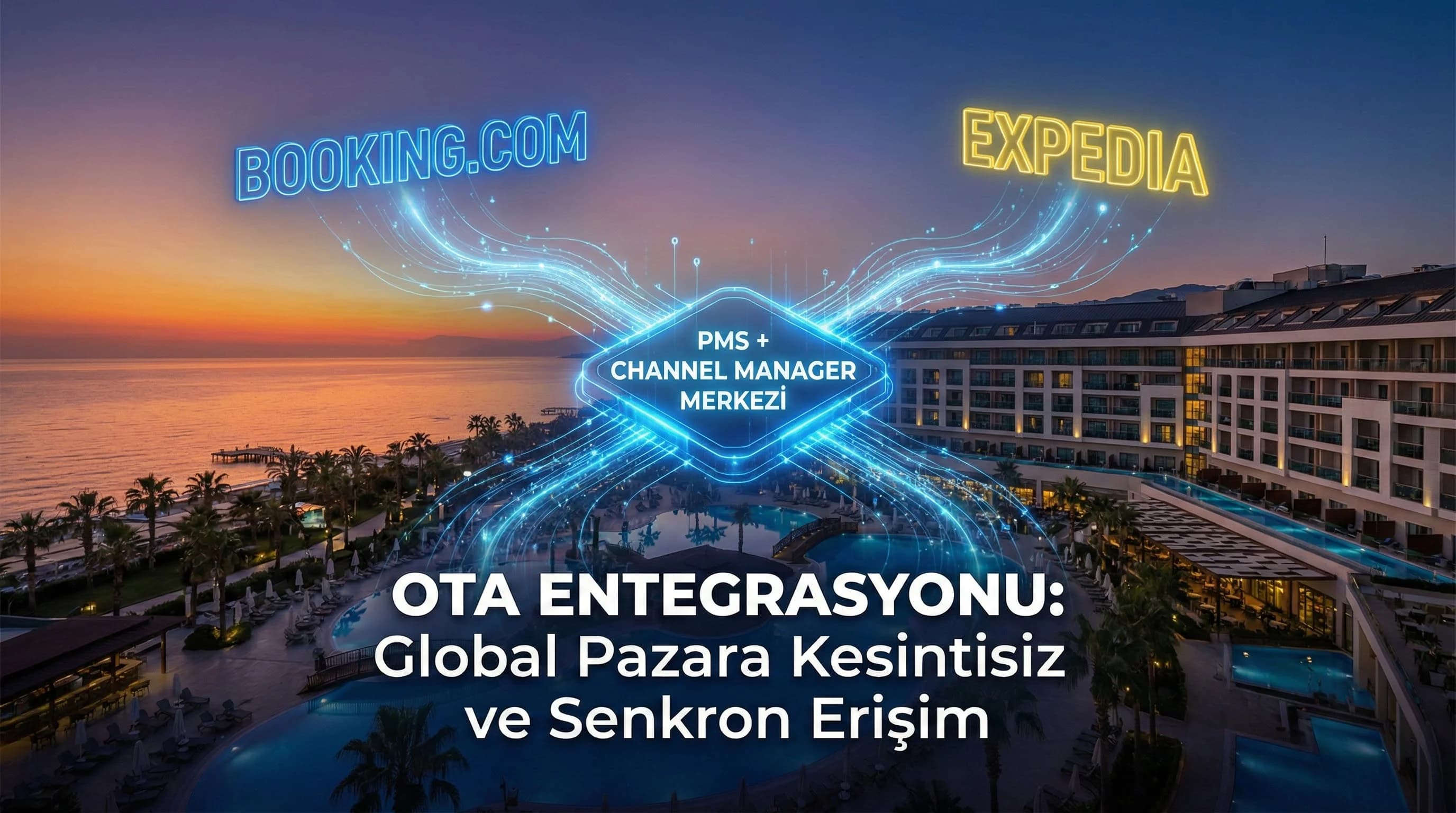
1. What is OTA integration and why is it important?
OTA integration is the automatic synchronous transfer of hotel inventory and price information (and often restrictions) to channels such as Booking.com, Expedia, Agoda. “Integration” here is not a one-time connection; It is a constant stream of data running at the heart of daily operation. If this flow is not designed correctly, what appears to be a “sale open” situation may actually mean incorrect prices, incorrect availability, or restrictions not working.
Why is it important? (Summary effects)
- •Reduces the risk of overbooking: prevents the same room type from overlapping across multiple channels.
- •Provides price consistency: web / OTA / B2B channel prices are kept under control.
- •It reduces the operational burden: the reception and reservation team performs “control and optimization” instead of “manual updating”.
- •It accelerates revenue management: you react faster to seasonal, occupancy and demand changes.
Short answer block of 4–5 items (as required by AEO)
- •OTA integration carries rate + inventory information to OTAs via PMS/channel manager.
- •The “single source of truth” is determined: PMS or channel manager is the main management panel.
- •OTAs send back the incoming reservation/cancellation; PMS and reporting are fed correctly.
- •Correct setup means price consistency + availability accuracy + working constraints.
- •Improper installation often produces the “invisible error”: lost revenue and guest dissatisfaction.
Mini example (resort scenario)
Think of a resort in Belek: You opened a last minute campaign for room type A. If the campaign price is updated in Booking and remains in Expedia, two different price perceptions occur on the same day. This situation is not just a loss of income; The guest asks “why is it different?” It also turns into a reputation risk.
☑ Mini Check: “Is there integration or not?”
- •When I update the price/room on at least one channel, is the other channel updated within 5–15 minutes?
- •Do the restrictions (min stay / stop sell) behave the same on every channel?
- •Is reservation cancellation processed correctly in PMS?
What should I do?
- • Determine the “single source of truth” (PMS or channel manager?).
- • Create a “matching map” for room types and rate plans.
- • Define 3 basic test scenarios: price change, stop-sell, cancellation.
- • With internal links (depth of knowledge): Review the PMS setup and channel management pages.
2. Basic logic of Booking & Expedia integration
Although Booking and Expedia have different extranet habits, their integration logic sits on the same core: • Room type • Rate plan (price plan) • Availability/inventory • Restrictions (restrictions: min stay, CTA, CTD, stop sell) Each of these parts lives as a “definition” in the PMS or channel manager. It also has an equivalent on the OTA side. Integration means “the correct match between definitions”.
The most common mistake: Mismatching rate plans and restrictions by saying "the room type is the same". Result: you think the system is working, but promotions, minimum stays or closing rules behave differently across a channel.
Let's simplify the basic logic (in hotel decision language):
- •Is “what I will sell” a room type or a package? (room vs package)
- •With which rate plans does my “price logic” proceed? (refund / non-refund / early booking)
- •What is my “rule set”? (min stay, stop sell, arrival/departure closure)
- •Do these definitions find a one-to-one correspondence in OTA?
Mini example (Antalya summer season):
You set a 3-night minimum stay rule in Antalya during peak summer months. If it works on Booking but not on Expedia, you will get a 1 night sale from Expedia. This disrupts the operation (room schedule, housekeeping rhythm) and skews revenue management.
☑ Mini Check: “Rate plan match”
- •Are Refundable/Non-refundable rate plans individually matched?
- •Is there a separate plan for promotions (EB, last minute) or a discount on the same plan?
- •Are the min stay / stop sell rules consistent on a channel-by-channel basis?
What should I do?
- • Organize rate plans with a “list → simplify → match” approach.
- • Decide to manage promotions in one place (the CM side is generally safer).
- • Establish a weekly check-in rhythm for “consistency across channels.”
3. How does the PMS + Channel Manager + OTA trio work?
This trio is actually a “distribution chain”. The most practical explanation is this: • PMS: The “operational reality” of the hotel (check-in/out, room status, guest records, stay flow). • Channel Manager: “distribution and rule engine” (rate, inventory, restriction distribution) to sales channels. • OTA: The showcase from which the request comes (visibility, conversion, reservation, cancellation).
Let's clarify the relationship per AIO: PMS → sends → Rates & Inventory → to Channel Manager → distributes → to OTA. In some installations, prices/restrictions are managed from the channel manager, not from the PMS; PMS only makes the reservation “last registration”. The important thing is to establish a single management point and avoid conflict.
Critical decision: Where is the “single source of truth”?
- •If the PMS is weak in price/constraint management, the channel manager becomes the center.
- •If PMS offers strong RMS/price rules, PMS can be the center; CM distributes.
- •Writing rules on both sides: the most common mistake.
Mini example (Side / Belt operation):
At the hotel in Side, the reception closes rooms via PMS and launches a campaign via marketing CM. If two different rules are written on two different panels on the same day, the sale will be closed in one OTA and remain open in the other. This produces a crisis such as “sales came from a channel, but the room was actually closed.”
☑ Mini Check: “Single source fact test”
- •Do we make price/restriction changes from a single panel?
- •Is the same rule written in two places? (PMS+CM)
- •Did we measure update latency? (5–15 minutes normal, hours risk)
What should I do?
- • In the organization, “who manages which panel?” Put the question in writing.
- • Clarify PMS/CM roles: PMS operation, CM deployment, and rules engine.
- • Plan at least 1 “end-to-end test day” (price change + stop sell + cancellation).
4. Basic rules of price and inventory flow
The “quality standard” of integration lies in these two questions: 1. Where is the price managed? (rate rules, promotions, packages) 2. Where is the inventory updated? (availability, allotment, stop-sell)
1) Rate rules – minimum set
- •Rate plan hierarchy: BAR, non-refundable, early booking, last minute…
- •Parity management: Control logic of Web/OTA/B2B prices
- •Commission impact: A look at net income after OTA commission (net ADR)
2) Inventory rules – minimum set
- •Availability based on room type: “Sellable rooms” logic, not “total rooms”
- •Stop-sell discipline: immediate closure in case of maintenance/operation/overbooking risk
- •Allotment and free selling: Clarifying not moving B2B allotments to OTAs
3) Restriction – the part that most hotels skip (the mini part that closes the Competitor gap)
A lot of content remains at “room and price”; The part that makes the difference is the correct management of constraints: • Min stay (minimum stay) • CTA/CTD (arrival/departure closure) • Stop sell (full closure) • Close to arrival / close to departure When these rules do not work correctly, you may think you are “managing occupancy” but you will receive unbalanced sales by channel.
Key Statistics / Data Point (smoothed benchmark): In some resort hotels, it is seen that a significant portion of online sales (where the OTA weight is high in most benchmarks) can be managed synchronously and without errors, with properly designed OTA integration; The critical thing is not to chase the rate, but to bring the cost of error close to zero.
☑ Mini Check: “3 layer rule”
- •Are rate plans simple or multiplied? (unnecessary plans risk)
- •Are inventory updates in one place?
- •Is our restriction set written and consistent across channels?
What should I do?
- • Simplify rate plans and pull them into the “main plan + promotion” structure.
- • Manage the inventory with the logic of “sellable room” and write a stop-sell procedure.
- • Pour the restrictions into a table and test them on each channel (min stay + CTA/CTD).
5. Impact of OTA integration on hotel revenue
While OTA integration may seem like a “technical setup,” it has three clear outcomes on the revenue side:
1) Visibility → Conversion effect
Visibility in OTAs is not only through advertising; It's also about accurate availability and competitive, consistent pricing. A room type that appears “closed” due to a mismatch lowers your visibility. This means fewer clicks, fewer reservations.
2) Operation error cost (hidden cost)
- •When overbooking, you don't just lose "a guest"; You generate an exponentially growing cost, including transfers, upgrades, refunds, reputation and staff time.
- •In price discrepancy, trust is broken when the guest sees "two different prices for the same room".
3) Revenue management speed
The right integration shifts your team's time from “manual updates” to “revenue optimization.” Fast action makes a difference, especially in destinations such as Bodrum, Kemer and Alanya, where seasonal demand changes sharply.
Mini example (Bodrum weekend request):
Weekend demand increased; You increased the BAR. If the update is delayed in a channel, you will be undersold and lose revenue on a “high demand day”.
☑ Mini Check: “Revenue impact measurement set”
- •Is there clear channel-based ADR tracking? (after commission)
- •Are overbooking / relocations recorded?
- •Are price discrepancy complaints monitored?
What should I do?
- • Establish channel reporting with a “net revenue” perspective (post commission).
- • Make error cost visible: keep an overbooking/relocation log.
- • Catch invisible errors with a weekly “rules and constraints” audit.
6. Checklist before OTA integration (the closing part that makes the difference)
The goal of this article is to clarify the “10 most critical things” before starting the integration. The mini box below provides an adequate framework to start the project without problems.
☑ Mini Check (Final): “Before starting the integration”
- •Has PMS release/integration competency been verified?
- •Was the channel manager selection made according to the number of OTAs and needs?
- •Have room types and rate plans been simplified?
- •Is restriction set (min stay/CTA/CTD/stop sell) written?
- •Have test scenarios been determined (price, stop-sell, cancellation, no-show)?
- •Are the roles clear: who is PMS, who leads the CM panel?
- •Is the internal link plan ready (guide → detailed articles)?
Internal link suggestions (compatible with Technical SEO note): • PMS installation: https://dgtlface.com/en/pms-ota/pms-integration • Channel management: https://dgtlface.com/en/pms-ota/channel-management • OTA management: https://dgtlface.com/en/hotel/ota-management • Silo hub (Assumption): https://dgtlface.com/en/pms-ota
7. OTA Integration Error Matrix (Operations + Revenue)
| Mistake | Root Cause | Solution | KPI impact |
|---|---|---|---|
| Overbooking | The sole source of truth is uncertain; inventory is updated from two panels | Set a single management panel; unify inventory flow; write stop-sell procedure | Overbooking rate decreases; guest satisfaction increases |
| Price discrepancy (cross-channel) | Rate plan match missing; promotion works differently | Rate plans “list→simplify→match”; Get promotion management in one place | Price consistency increases; net ADR is maintained |
| Stop-sell / restriction does not work | Restriction set is not available in OTA; missing mapping | The restriction table appears; Run min stay/CTA/CTD/stop-sell test cases | Operation stability increases; cancellations/complaints are reduced |
| Cancellation/no-show is processed incorrectly in PMS | The feedback flow is broken; PMS integration competency not verified | PMS version/integration control; end-to-end cancel/no-show test day | Cancellation rate tracking is accurate; reporting quality increases |
| Update delay (latency) is high | Channel/PMS services are lagging; no alarm threshold | Measure latency; set alarm thresholds; Simulate peak season scenario | Loss of income is reduced; rapid action becomes possible |
8. Preparation Checklist Before OTA Integration - PMS & OTA Management (v1.0)
Preparation Checklist Before OTA Integration - PMS & OTA Management (v1.0)
This checklist has been prepared for you to quickly verify the hotel's room type–rate plan–constraint–inventory mappings before starting the Booking/Expedia integration. The goal is to catch the "invisible errors" (price inconsistency, stop-sell not working, cancellation flow disorder) that occur after the go-live, at the installation stage. As a result, the team moves the integration to the “we measured and verified” level rather than the “we connected it” level.
Kim Kullanır?
Reservations manager, revenue manager (RM), front office lead, and agency/IT on the integration side.
Nasıl Kullanılır?
- Remove the room type and rate plan list from PMS + channel manager panels.
- Verify the matching and ruleset with the checklist below.
- Complete the tests and go live with the 14-day sprint plan.
Ölçüm & Önceliklendirme (Kısa sürüm)
- ▢ ✅ “Single source of truth” chosen: PMS or CM?
- ▢ ✅ Room types are simple and clear: “sellable room” logic is ready
- ▢ ✅ Rate plans clear: BAR / refundable / non-refundable / promotions
- ▢ ✅ Restriction set written: min stay / CTA / CTD / stop-sell
- ▢ ✅ There is a channel-based test list: Booking + Expedia + (Agoda, etc. if available)
- ▢ ✅ Reservation cancellation/no-show flow is processed towards PMS
- ▢ ✅ Update latency measured (latency)
- ▢ ✅ Reporting KPIs were determined (overbooking, net ADR, parity)
PDF içinde: Problem→Kök Neden→Çözüm tablosu + 14 gün sprint planı + önce/sonra KPI tablosu
Bir Sonraki Adım
Clarify risks and quick wins based on your current PMS/CM structure in 15 minutes.