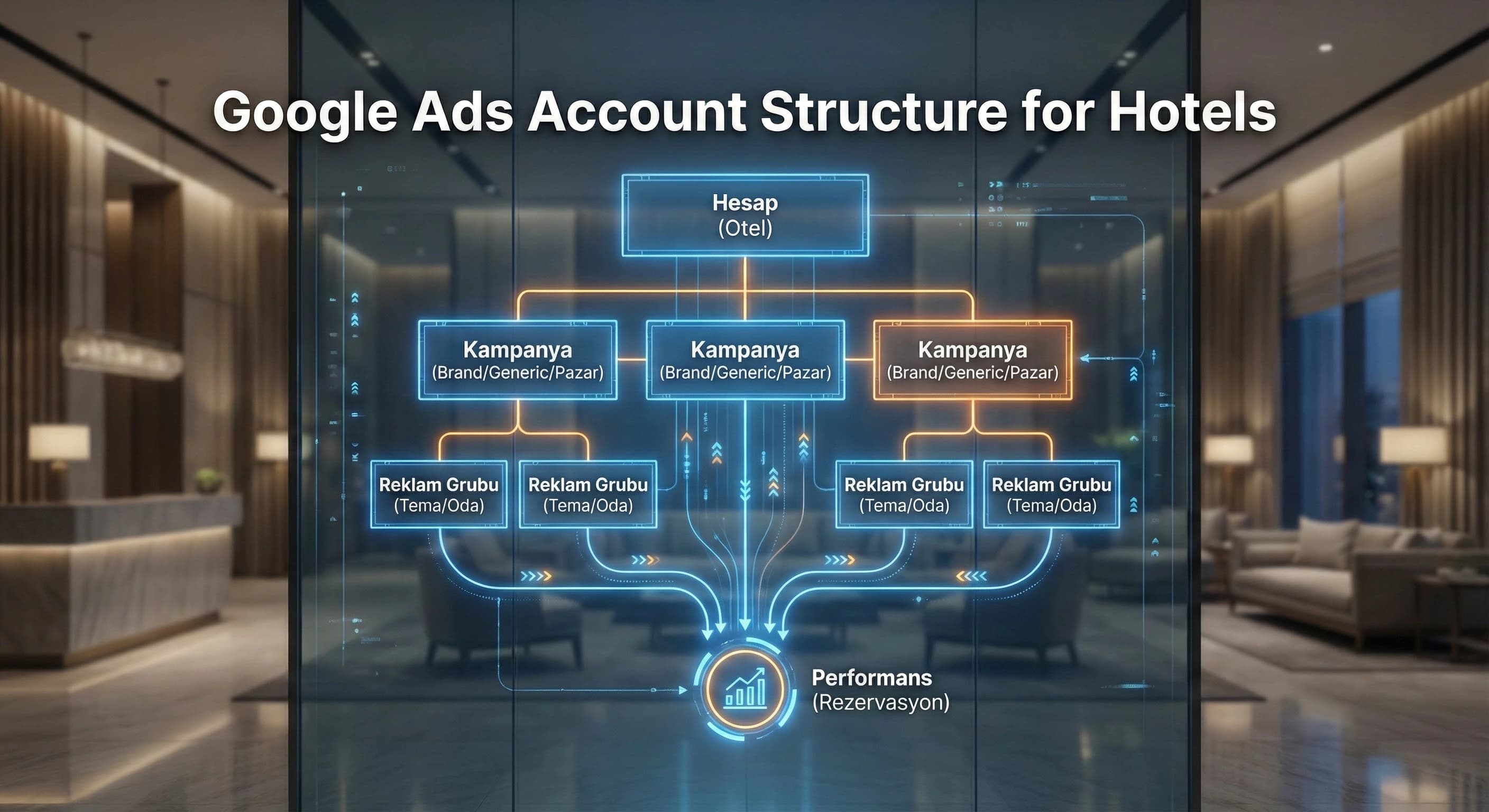
1. Campaign Structure Logic (Why Architecture = Performance?)
In a hotel you need to answer all of these questions at the same time:
- •Am I missing brand calls?
- •Which query makes money in destinations like Antalya/Belek?
- •Should the German or Russian market be managed separately?
- •Are conversions decreasing on mobile?
All of these questions can only be answered if your account structure is “readable”. Google Ads' own help documents also recommend setting up the account/organization with logic such as "category or business goal" and feeding it from the site structure (landing pages).
What should the Google Ads campaign structure be like?
Clear answer (2–3 sentences): Campaign structure in the hotel account; It should be established according to business goal + intent + market breakdown. Brand and generic should be separate campaigns; Large breakdowns such as country/language should be managed at the campaign level, while the theme/segment (room type, concept) should be clear at the ad group level. “Stuffing everything into one campaign” distorts the report and slows down optimization.
What should I do?
- •First write 4 columns: Brand / Generic / Country-Language / Segment
- •Then distribute each column towards the campaign–ad group level (with the template below)
2. Account Organization for Hotel (Single Hotel or Multiple Hotels?)
Single hotel scenario (cleanest start)
The ideal approach for a single hotel:
- •Campaign breakdown: Brand and Generic
- •Market breakdown: Türkiye + (if any) Germany + Russia
- •Segment breakdown: clear themes such as “family”, “adult only”, “spa”, “beachfront” or “room type”
The aim here is; It is not a "lot of campaign", but a small but readable architecture.
Multiple hotel (multi-property) scenarios in one account
There are two safe ways in this scenario:
In practice, if the hotels are very different from each other (Belek resort vs Bodrum boutique) the “hotel based” distinction is cleaner.
What should I do?
- •Naming convention is a must in multi-property: use OTEL_KODU + MARKET + BRAND/GENERIC standard in the campaign name.
- •Clarify the landing match 100%; Otherwise, hotels will "pollute" each other's traffic.
3. Campaign–Advertising Group–Keyword Hierarchy (Right Decision on the Right Layer)
Campaign in Google Ads; carries “upper settings” such as budget, location, language; The ad group brings together similar keywords and ads.
That's why putting decisions in the right layer adds speed:
Put it at campaign level (for control + reporting)
- •Brand vs Generic
- •Country / market (Türkiye, Germany, Russia)
- •Language (TR/EN/DE/RU)
Put it at ad group level (for theme + intent)
- •Room type (standard, suite, family)
- •Concept (all inclusive, honeymoon, spa)
- •Destination sub-themes (Belek golf, Side family, Kemer nature)
Keyword set logic (modern practice)
Instead of breaking down excessive micro keywords; intent/theme focused sets are more sustainable. Because matches and automation (smart bidding, close variants) on the Google side may not make microstructures as advantageous as before.
What should I do?
- •Set up “budget control” at the campaign level, set up “theme clarity” at the ad group level.
- •Set a single “main landing” for each ad group (room/concept page).
4. Brand vs Generic (Why Leave a Hotel Account)
Brand campaigns generally generate “warmer” traffic because the user already knows about your hotel; Generic searches, on the other hand, return higher volume, but intent may be more dispersed.
That's why many account structure guides emphasize separate management of branded campaigns.
Why should brand and generic campaigns be separated?
If brand and generic are not separate, budget and report “mix”: brand brings high conversions at low cost, while generic is more expensive but with scale. Distinction; It allows you to protect the budget, read the performance accurately and optimize according to the target. Additionally, when the brand budget is reduced, generic campaigns can capture brand queries and the report may be misleading.
Brand campaign (campaign):
Ad groups: “hotel name + variation”, “hotel name + price”, “hotel name + reservation”
Generic campaign (campaign):
Ad groups: “belek resort”, “antalya all inclusive”, “side family hotel”, “kemer seaside”
Note: “Room type” name groups can also be opened in Generic (suite, family).
Key Statistics / Data Point (row + realistic frame):
- •Brand searches generally tend to have a higher conversion rate; Generic, on the other hand, may carry higher volume but lower conversion potential.
- •Assumption (safe phrase for benchmark in the line): In some hotels, brand campaigns can reach very high CVRs (e.g. 40%+); This depends on brand awareness + landing quality + market conditions.
What should I do?
- •Consider the brand campaign “budget protected” (keep it always open).
- •Control market/language breakdowns when scaling Generic.
5. GEO + Language + Country Breakdowns (The “Market” in Tourism Determines the Architecture)
Although hotel advertising may seem like a “single country,” in practice markets differ in behavior. Even the search intent of Antalya–Belek resort and Bodrum boutique hotel is different; When the German and Russian markets are added, the language/currency/message also changes.
When a separate campaign? When is the same campaign?
- •Separate campaign: If markets require different language/landing (DE/RU separate), budget control is critical
- •Same campaign: If it is a small-scale start-up to be managed with a single language/single landing (Assumption: limited budget)
Hotel example
- •Belek / Antalya: “resort + all inclusive + family” themes
- •Side: “family + child” themes
- •Kemer: “nature + seaside” themes
- •Bodrum: “boutique + view + premium” themes
What should I do?
- •If targeting Germany/Russia: use standard MARKET_DE / MARKET_RU in the campaign name.
- •Just turning on targeting without ensuring language/landing harmony will reduce conversions.
6. Device Breakout (When Does Mobile/Desktop Distinction Make Sense?)
Mobile and desktop user behavior may differ in hotels: search is higher on mobile, payment/booking rate may be better on desktop (varies by market).
When is it necessary to reserve the device at the campaign level?
- •If the budget is big and device performance is very different
- •If the landing experience differs according to devices (mobile page is simpler, desktop is more detailed)
- •If the bid strategy will differ on a device basis
Otherwise, it might be cleaner to manage device breakdown with “reporting + tuning” rather than a campaign.
What should I do?
- •See the device breakdown in the report first: Is the CTR/CVR/CPA difference really big?
- •If there is a big difference, open a device campaign; Otherwise, a single campaign + device bid setting is sufficient.
7. Bid Strategy Compatibility (Architecture + Optimization Should Work Together)
If the account architecture is not aligned with the bid strategy, you will give Google the “wrong signal”. Example: if brand and generic are in the same campaign, smart bidding can be loaded on the “easy conversion” brand; This slows down generic growth.
Why is extreme microstructure (SKAG) not always a good idea?
Single-keyword hyper-granular structures such as SKAG; Although it provided a control advantage in the past, “default” is not preferred in every account due to the expansion of matches and automation in the modern era; should be selected according to account needs.
Practical advice: “Intent sets” (theme-based ad group) + strong ad copy + the right negative words are more sustainable on most hotel accounts.
What should I do?
- •First, make the architecture “readable”; Then activate smart bidding.
- •Separate brand and generic; otherwise the optimization strategy becomes blurred.
8. Download Sample Campaign Structure Template — SEM / Hotel Google Ads Architecture Template (v1.0)
Download Sample Campaign Structure Template — SEM / Hotel Google Ads Architecture Template (v1.0)
This template allows you to plan brand/generic, country/language, GEO, device and segment breakdowns on a single page when setting up a hotel Google Ads account. Between the agency and the hotel, "who sets up what?" reduces clutter and produces scalable naming conventions.
Kim Kullanır?
Agency manager, performance specialist, hotel sales-marketing manager.
Nasıl Kullanılır?
- Fill in the blank fields according to your hotel (market, language, destination, segment).
- Compare it with the example structure and complete the missing breakdowns.
- Verify before going live with the post-installation checklist.
Ölçüm & Önceliklendirme (Kısa sürüm)
- ▢ ✅ Brand and generic campaigns are separated
- ▢ ✅ Country/language breakdowns are clear at the campaign level
- ▢ ✅ Ad group themes are set up with “intent sets”
- ▢ ✅ Each ad group depends on a single main landing
- ▢ ✅ Measurement events tested
- ▢ ✅ Naming convention put into writing
- ▢ ✅ Brand/generic can be seen separately in reporting
PDF içinde: Problem→Kök Neden→Çözüm tablosu + 14 gün sprint planı + önce/sonra KPI tablosu
9. Result: Exemplary “Golden Architecture” for Hotels
Golden rule: Architecture; Provides budget control + report readability + landing matching. Think of your Google Ads account as an “operations manual”: someone should be able to open it and understand it even when you're not around.
Recommended Architecture (summary):
• Campaigns: 1. BRAND_TR 2. GENERIC_TR_GEO (Antalya/Belek/Side/Kemer/Bodrum themes) 3. (If applicable) GENERIC_DE / GENERIC_RU • Ad groups: concept/room type/intent sets • Each ad group: single main landing + clear message
Bir Sonraki Adım
Let's map your existing account (brand/generic, country/language, device, segment) and create a reconstruction plan in a single meeting.